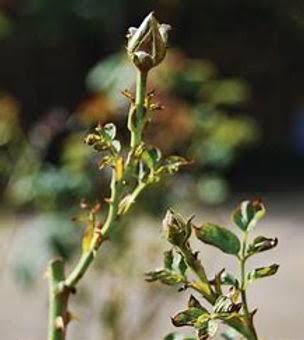
What does thrips damage look like on roses?
Thrips damage shows on the flowers, not the foliage: petals emerge with brown, scorched edges and silvery streaks, buds open distorted or fail to open, and light-colored blooms are hit hardest. The insects themselves are barely visible — slivers the size of a pencil line that dart into the bloom when disturbed. Tap an unopened bud over white paper to see them.
- Petals with brown, dried edges and silvery or bruised streaks
- Buds that open partially, deform, or brown and stall before opening
- Streaks of scattered pollen knocked loose inside the bloom
- Sliver-like insects darting out of dissected buds; light-colored roses hit hardest
Why are thrips so hard to get rid of?
Thrips hide where sprays barely reach: tucked deep inside unopened buds and, in part of their life cycle, down in the soil and debris as pupae. A spray that kills the adults in one bud does nothing to the pupae in the mulch or the colony in the next unopened bud, so new damage keeps appearing until you spray on a schedule and clean up the debris they pupate in.
Populations peak in the hot, dry stretches of summer, and they blow in readily from surrounding fields and weeds — which is why even a perfectly clean rose bed can suddenly show damage.
How do you treat thrips on roses?
Cut and bin every damaged bloom — each one is a nursery. Then spray the unopened buds and surrounding foliage with insecticidal soap or spinosad, repeating every five to seven days for two to three weeks so the treatment catches each generation as it emerges. Blue sticky traps hung among the bushes monitor and reduce adult numbers.
Because thrips feed inside buds, spraying open blooms does little — the payoff is in protecting the buds before they open. Spray in the evening so you are not hitting pollinators, and alternate products so resistance does not build.
- 1
Remove and dispose of every damaged bloom — do not leave it on the plant or in the bed.
- 2
Spray unopened buds thoroughly with insecticidal soap or spinosad (Monterey Garden Insect Spray, also sold as Captain Jack’s Deadbug Brew), coating the bud tips where thrips hide.
- 3
Repeat every 5–7 days for two to three weeks to catch newly hatching generations.
- 4
Hang blue sticky traps near the bushes to monitor and trap adults.
- 5
Refresh mulch and clear plant debris beneath the roses to remove the sites where thrips pupate.
How do you prevent thrips on roses?
Prevention is mostly sanitation and restraint: deadhead and dispose of spent blooms before thrips can pupate in them, keep beds clean of debris in fall, and avoid broad-spectrum insecticides that kill the predatory mites and pirate bugs that suppress thrips naturally. In thrips-prone regions, blue traps up in spring tell you when to begin bud sprays before damage starts.
- Deadhead regularly and bin spent blooms rather than dropping them in the bed
- Clear fall debris and refresh mulch to remove overwintering and pupation sites
- Avoid broad-spectrum insecticides that wipe out thrips’ natural enemies
- Hang blue sticky traps in spring as an early-warning monitor
- Expect and treat the summer peak — start bud sprays before damage, not after
Common questions
Related guides
Aphids on Roses: Signs, Treatment & Prevention
Aphids are small, soft-bodied sap-sucking insects that cluster on rose buds and tender new shoots, leaving sticky honeydew, curled growth, and ants in their wake. Treat them with a firm spray of water, insecticidal soap, or by wiping small clusters off by hand — repeat as needed. Prevent outbreaks by holding back on nitrogen-heavy feeding and letting ladybugs and lacewings do the patrol work.
Read the guide PestSpider Mites on Roses: Signs, Treatment & Prevention
Spider mites are tiny sap-sucking arachnids that leave rose foliage stippled and bronzed with fine webbing on leaf undersides, and they explode during hot, dry weather. Treat them by blasting leaf undersides with a hard stream of water daily for about a week, following with insecticidal soap or a miticide for heavy infestations. Keep plants hydrated and dust down to prevent them.
Read the guide PestJapanese Beetles on Roses: Control & Prevention
Japanese beetles skeletonize rose foliage and mob blooms from June through August. Control adults by knocking them into soapy water each cool morning, using targeted sprays only for heavy damage, and treating lawns for grubs in late summer to shrink next year’s population. Never use pheromone traps — they lure far more beetles to your garden than they catch.
Read the guideKeep this guide in your pocket
PetalPals journals every rose you grow, reminds you when to spray and feed, and helps you identify problems from a single photo — free to join.