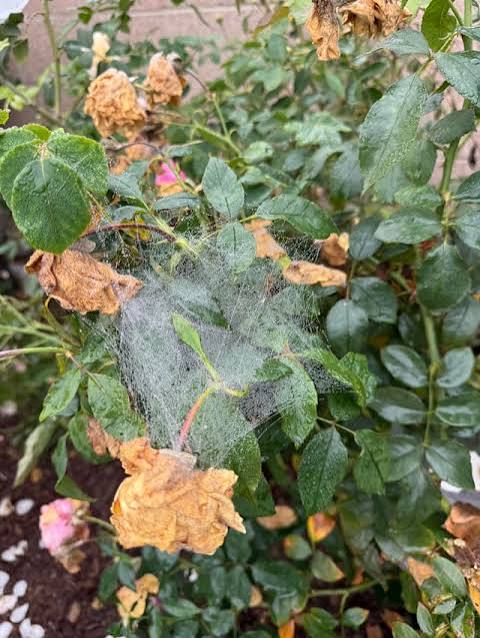
What are spider mites?
Spider mites are microscopic arachnids — cousins of spiders, not insects — that puncture leaf cells and suck out the contents. On roses, the two-spotted spider mite is the usual culprit. Their life cycle runs just one to two weeks in hot weather, so a small population can turn into a visible infestation almost overnight in midsummer.
They congregate on the undersides of leaves, which is why infestations often look advanced by the time the damage shows on the upper surface. Warm, dry, dusty conditions with drought-stressed plants are their ideal environment.
What do spider mites look like on roses?
The first sign is stippling — tiny pale dots where cells have been sucked dry — followed by a dull bronze or gray cast to the whole leaf, and in heavy infestations fine silk webbing stretched across leaf undersides and growing tips. Tap a suspect leaf over white paper: mites show up as moving specks the size of dust.
- Fine light dots (stippling) scattered across the upper leaf surface
- A bronzed, dusty, or gray look to older leaves
- Fine webbing on leaf undersides and between stems in heavy infestations
- Moving pinprick specks when a leaf is tapped over white paper
- Outbreaks that spike during heat waves and dry spells
How do you treat spider mites on roses?
Spider mites are unusually easy to knock back with water: a hard spray to leaf undersides daily for five to seven days breaks the reproduction cycle without any chemicals. Follow with insecticidal soap or horticultural oil for remaining colonies, and reserve true miticides for severe or recurring infestations. Never use broad-spectrum insecticides — they kill the predatory mites that keep spider mites in check.
- 1
Spray the undersides of all leaves with a firm jet of water from the hose, repeating daily for five to seven days.
- 2
Follow up with insecticidal soap or a light horticultural oil, coating leaf undersides thoroughly.
- 3
For heavy or recurring infestations, apply a miticide labeled for spider mites — Bonide Mite-X is the common garden-center option, with Avid (abamectin) as the professional standby — rotating products so the mites do not develop resistance.
- 4
Deep-water the plant and rinse dust from foliage — drought-stressed, dusty leaves attract mites.
- 5
Prune out and dispose of the worst-infested, webbed growth rather than trying to save it.
How do you prevent spider mites on roses?
Prevention is about keeping the plant unstressed and the natural enemies alive: water deeply during heat, rinse dust off foliage periodically, mulch to keep conditions humid at the soil surface, and avoid any broad-spectrum insecticide in the garden, because it kills the predatory mites and lady beetles that suppress spider mites naturally.
- Water deeply during heat waves — stressed plants are mite magnets
- Hose dusty foliage off occasionally, especially near paths and driveways
- Mulch beds to moderate heat and dryness at the soil surface
- Avoid unnecessary insecticide sprays that wipe out predatory mites
- Inspect leaf undersides weekly in midsummer, before webbing appears
Common questions
Related guides
Aphids on Roses: Signs, Treatment & Prevention
Aphids are small, soft-bodied sap-sucking insects that cluster on rose buds and tender new shoots, leaving sticky honeydew, curled growth, and ants in their wake. Treat them with a firm spray of water, insecticidal soap, or by wiping small clusters off by hand — repeat as needed. Prevent outbreaks by holding back on nitrogen-heavy feeding and letting ladybugs and lacewings do the patrol work.
Read the guide PestThrips on Roses: Signs, Treatment & Prevention
Thrips are sliver-thin insects that rasp and feed inside rose blooms, leaving petals with brown, scorched edges and buds that open distorted or stall entirely. Treat them by removing and binning damaged blooms, spraying unopened buds with insecticidal soap or spinosad, and hanging blue sticky traps. Prevent them by cleaning up spent blooms and letting natural predators work.
Read the guide Care & DiagnosisWhy Are My Rose Leaves Turning Yellow?
Yellowing leaves are a symptom, not a single disease. The pattern tells the story: yellow with black spots means black spot; yellow between green veins points to chlorosis; evenly yellow, dry leaves mean drought; and scattered yellow lower leaves in late summer can simply be natural aging. Match your pattern below to find the cause and the fix.
Read the guideKeep this guide in your pocket
PetalPals journals every rose you grow, reminds you when to spray and feed, and helps you identify problems from a single photo — free to join.