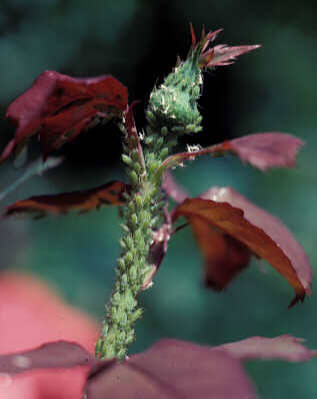
How do I know if my roses have aphids?
Aphids announce themselves in clusters: dense colonies of green, pink, or black soft-bodied insects packed along new shoots, bud bases, and the undersides of young leaves. The damage shows as curled, puckered growth and buds that stall, plus shiny honeydew on leaves below and ants marching up the canes to farm the colony.
- Clusters of small, soft, pear-shaped insects on buds and new growth
- Curled or puckered young leaves and stalled buds
- Sticky, shiny honeydew coating leaves beneath the colony
- Black sooty mold growing on the honeydew in heavy cases
- Ants streaming up and down the canes — they protect and farm aphids
Do aphids harm roses?
On an established rose, aphids are mostly a cosmetic nuisance: they distort the current flush of buds and look unpleasant, but the shrub outgrows the damage. Real harm comes with heavy, persistent infestations — repeated flushes of distorted blooms, sooty mold shading leaves, and, on young or newly planted roses, enough stress to slow establishment. Natural predators usually collapse an outbreak within weeks.
Because aphids favor tender new growth, an infestation that spikes right after a heavy nitrogen feeding usually self-corrects once that soft growth hardens off.
How do you get rid of aphids on roses?
Start with water: a firm jet from the hose knocks aphids off and most never find their way back. Hand-wipe small clusters on buds, use insecticidal soap for thorough coverage of shoots and leaf undersides, and only reach for stronger insecticides when an infestation is truly severe — they kill the ladybugs and lacewings that provide long-term control.
- 1
Blast the colonies off new shoots and buds with a firm jet of water, hitting undersides and bud bases.
- 2
Hand-wipe remaining clusters on buds between thumb and finger — quick and surprisingly effective.
- 3
Spray insecticidal soap or a light horticultural oil for heavier infestations, coating the colonies directly; repeat every few days for two weeks.
- 4
Control ants on the bush (a sticky band on the lower cane works) so they stop protecting the aphids.
- 5
Hold off broad-spectrum insecticides unless the infestation is severe — they destroy the predator insects that keep aphids down for the rest of the season.
How do you prevent aphids on roses?
Prevention works through balance: feed moderately so the plant is not pushing unnaturally soft growth, wash off the first colonies you see before they multiply, and — most importantly — avoid unnecessary insecticides so lady beetles, lacewings, and parasitic wasps patrol your garden. A garden with healthy predator populations rarely sees aphids get past the first few buds.
- Feed moderately and avoid nitrogen-heavy fertilizers that trigger soft, sappy growth
- Inspect bud tips and new shoots weekly in spring and remove the first colonies by hand
- Grow a diversity of flowers nearby to support ladybugs, lacewings, and parasitic wasps
- Keep ants off roses so they cannot protect aphid colonies
- Spray aphid-prone tips with water routinely in spring rather than waiting for a colony to build
Common questions
Related guides
Spider Mites on Roses: Signs, Treatment & Prevention
Spider mites are tiny sap-sucking arachnids that leave rose foliage stippled and bronzed with fine webbing on leaf undersides, and they explode during hot, dry weather. Treat them by blasting leaf undersides with a hard stream of water daily for about a week, following with insecticidal soap or a miticide for heavy infestations. Keep plants hydrated and dust down to prevent them.
Read the guide PestThrips on Roses: Signs, Treatment & Prevention
Thrips are sliver-thin insects that rasp and feed inside rose blooms, leaving petals with brown, scorched edges and buds that open distorted or stall entirely. Treat them by removing and binning damaged blooms, spraying unopened buds with insecticidal soap or spinosad, and hanging blue sticky traps. Prevent them by cleaning up spent blooms and letting natural predators work.
Read the guide PestJapanese Beetles on Roses: Control & Prevention
Japanese beetles skeletonize rose foliage and mob blooms from June through August. Control adults by knocking them into soapy water each cool morning, using targeted sprays only for heavy damage, and treating lawns for grubs in late summer to shrink next year’s population. Never use pheromone traps — they lure far more beetles to your garden than they catch.
Read the guideKeep this guide in your pocket
PetalPals journals every rose you grow, reminds you when to spray and feed, and helps you identify problems from a single photo — free to join.