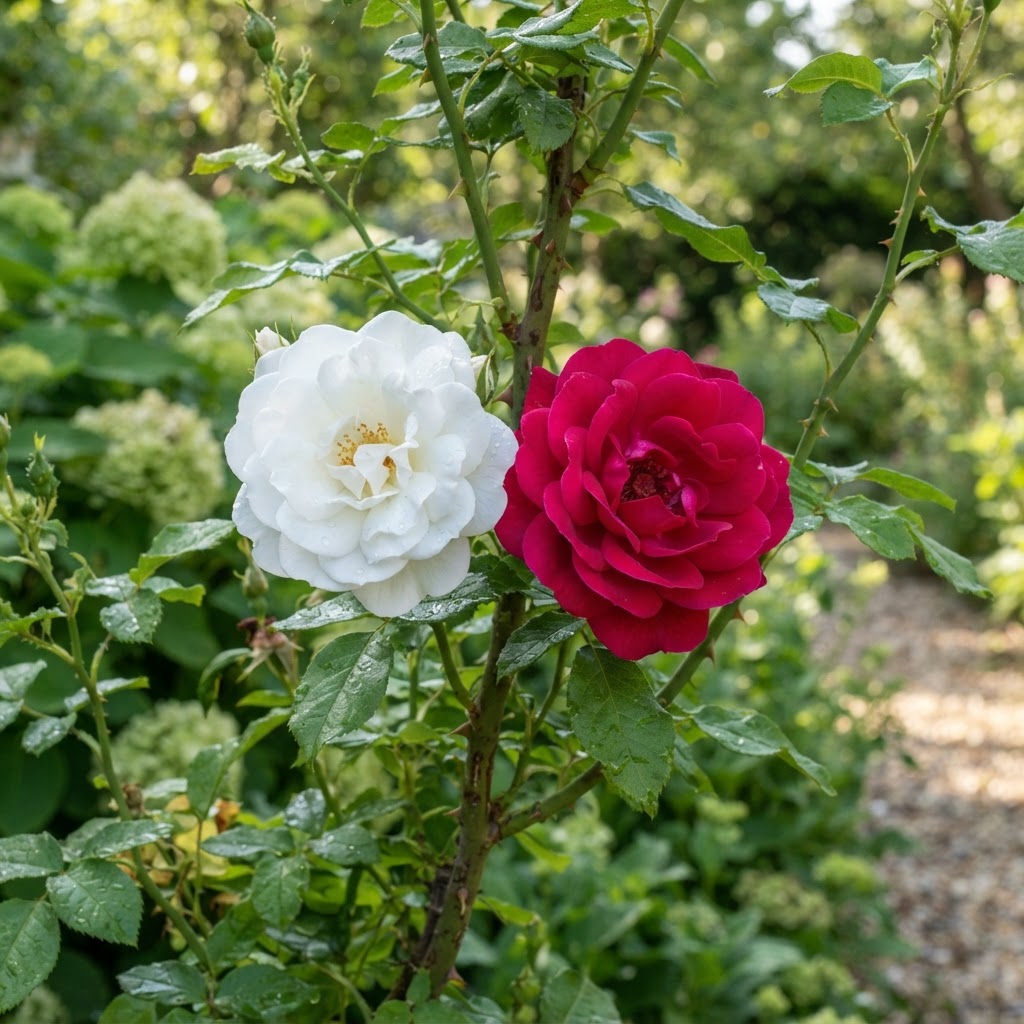
What is a rose sport?
A sport is a segment of a plant — often a single cane or branch — that is genetically different from the rest of the plant. In roses, sports most often change habit (a bush rose produces a climbing cane) or flower color (a red rose produces a cane with white, striped, or deeper blooms).
The mutation happens in the growing tip of the cane, in a single cell that then divides and builds the whole shoot. Because the change lives in that cane’s tissue, only the growth that descends from the mutated cell shows the new trait — the rest of the bush carries on as before.
When the mutation involves distinct cell layers of the growing tip keeping different genetics, the result is a chimera — the two-toned striped roses like Rosa mundi. Every chimera is a sport, but not every sport is a chimera.
How do rose sports happen?
Sports arise from spontaneous mutations in the meristem — the cluster of dividing cells at a growing tip where every new cane, leaf, and petal is formed. Most mutations do nothing visible, and most visible ones are subtle: a slightly different tint, a fuller petal count, a longer cane.
Occasionally a mutation lands somewhere that matters — a pigment gene, a growth-hormone pathway, a thorn gene — and a visibly different cane results. Breeders can’t force it in a garden setting; they can only watch for it, and roses produce so much new growth each season that odd canes appear surprisingly often.
This is also why propagated sports are “new varieties” rather than new plants. Take a cutting from the mutant cane, root it, and every plant grown from that cutting repeats the new trait. That’s how a single odd branch becomes a cultivar sold around the world.
Famous roses that started as sports
Sports have quietly created some of the most-loved roses ever sold. A few standouts:
Notice the pattern: sports rarely invent a whole new rose — they take a proven winner and give it a second life. Same flower, new body or new coat.
- New Dawn — a repeat-blooming sport of Dr. W. Van Fleet, discovered in 1930. It made history twice: once as a beloved climbing rose, and once as the recipient of U.S. Plant Patent No. 1 — the first plant patent ever granted.
- Climbing Iceberg — the world’s favorite white floribunda, Iceberg, threw a climbing sport with the same clouds of white blooms on a big rambler frame.
- Chicago Peace — the legendary ‘Peace’ produced a sport found growing in a Chicago garden, with the same big blooms in deeper, warmer pink and gold tones.
- Rosa mundi — the ancient striped rose itself, a color sport of the crimson Apothecary’s Rose that became a chimera with two pigment layers.
If your rose throws a sport
It happens in ordinary gardens more often than you’d expect: one cane blooms a different color, or a bush suddenly sends up a monster cane that wants to climb a tree. If the sport is charming, you can try to capture it.
If the sport is ugly or unwelcome — a reverted cane on a striped rose, for instance — prune it out at the base so the parent stays dominant. Either way, photograph it: your garden just did something a breeder would charge money for.
- Let the sport cane bloom and grow long enough to show the trait is stable, not a one-off
- Take a cutting from the sport cane only — wood from the rest of the bush grows the original rose
- Label the new plant clearly; you now have a mother plant and its sport
Common questions
Related guides
Chimera Roses Explained: Nature’s Two-Tone Roses
A chimera rose is a single rose bush carrying two genetically different sets of cells, layered on top of each other in the growing tips. When those two cell lines produce different petal colors, every bloom gets painted in striking two-tone stripes or sectors — sometimes split cleanly down the middle. Chimeras arise by spontaneous mutation, survive only through cuttings and grafting, and include some of the most famous striped roses in history, like Rosa mundi.
Read the guide Fun FactsThe World’s Oldest Living Rose: The 1,000-Year-Old Rose of Hildesheim
The oldest known living rose is a wild dog rose (Rosa canina) growing against the apse wall of Hildesheim Cathedral in Germany. Its existence has been documented for roughly seven hundred years, local legend traces it back more than a thousand — and in 1945, when Allied bombing destroyed the cathedral around it, the rose’s roots survived and it grew back.
Read the guide Top 10 ListsTop 10 Multicolored & Striped Roses
The best multicolored roses span four centuries: Rosa Mundi and Ferdinand Pichard for classic candy-striping, Fourth of July for a striped climber, and Peace for the most famous bicolor of all. Every pick below holds its pattern reliably (stripes do vary a little with temperature), and together they cover every garden use — shrub, climber, pillar, and pot.
Read the guideKeep this guide in your pocket
PetalPals journals every rose you grow, reminds you when to spray and feed, and helps you identify problems from a single photo — free to join.