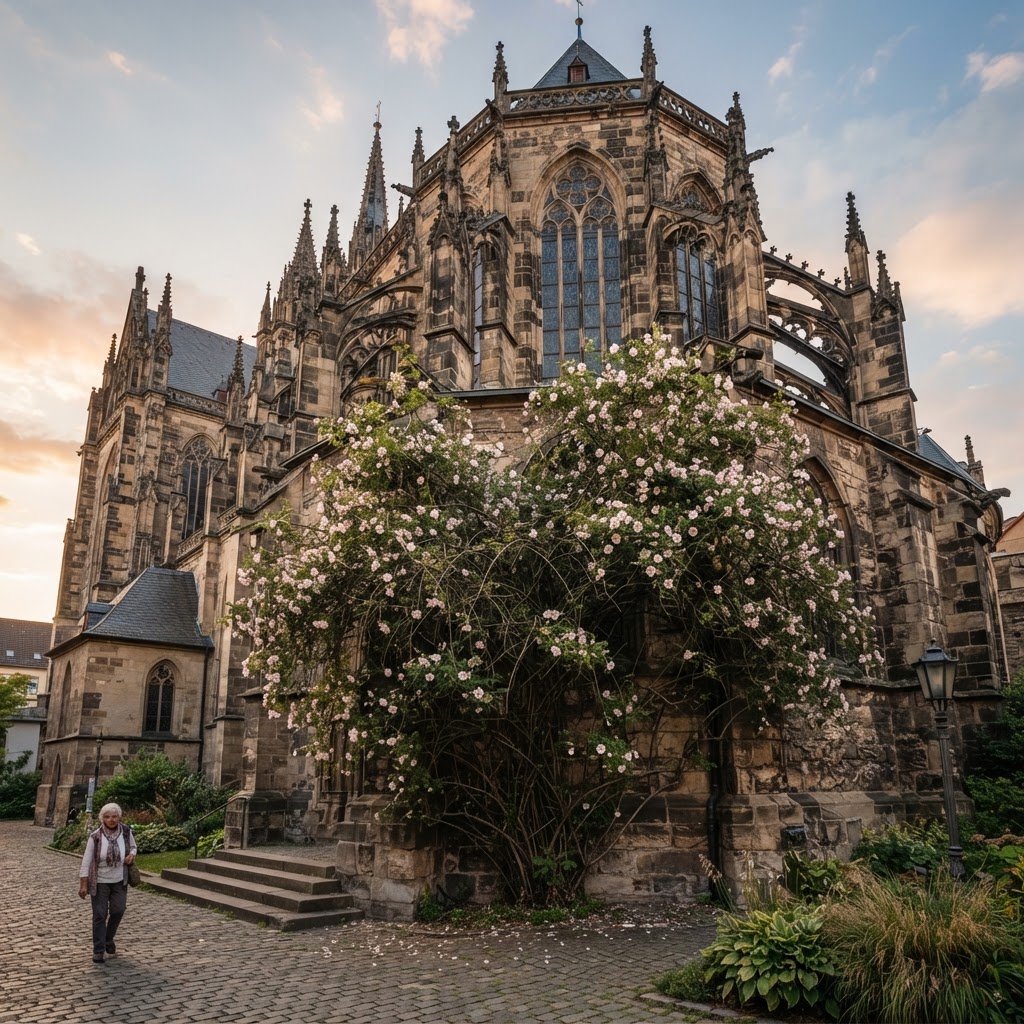
The rose on the cathedral wall
On the outer apse wall of Hildesheim Cathedral grows a Rosa canina — a wild dog rose — believed to be the oldest living rose on Earth. It forms a huge, sprawling tangle of arching canes studded in late spring with pale pink, five-petaled blooms, each about as wide as a thumb.
The rose’s existence at the cathedral has been documented for around seven hundred years, making it the oldest living rose on record. Local tradition, though, ties it to the very founding of the diocese — legends claim the rose was already growing when Emperor Louis the Pious was hunting in the area in the early ninth century, a thousand years before anyone photographed it.
Historians treat the 815 AD founding legend as exactly that — a legend. But even the conservative, documented age makes this plant older than most family trees, and it has watched the cathedral beside it burn, collapse, and get rebuilt more than once.
How does a rose live a thousand years?
The secret isn’t the canes — no single rose cane lives centuries. The Hildesheim rose survives through its root and crown, which the protected cathedral wall shelters from wind, sun-scald, and careless spades. Old canes die and new ones sprout from the same root system, so the plant is less one rose bush than one continuous rose lineage.
Dog roses are also genetically tough: tough, adaptable, and famously long-lived for a wild species. Give a healthy dog rose a protected stone wall, a cool root run, and seven hundred years of gardeners deciding it’s worth keeping, and you get a legend.
It survived the bombing — twice over
On March 22, 1945, the last Allied air raid on Hildesheim destroyed the cathedral. The ancient rose, growing at the base of the apse, was buried under rubble and burned — and everyone assumed the city had lost its thousand-year survivor.
The roots were alive. Within months, new shoots pushed out of the ashes, and the rose grew back over the rebuilt wall. Today it is arguably the most celebrated plant in Germany — a city symbol, celebrated on postcards, and quietly proof that a rose’s root system can survive almost anything above ground.
Other ancient roses worth a pilgrimage
If a trip to Hildesheim isn’t on the calendar, a few other famously old roses are worth knowing (and Hildesheim is, happily, still growing, so all three are visitable):
- The Tombstone rose (Tombstone, Arizona) — a Lady Banks rose planted in 1885 that has grown into the largest rose bush in the world, covering roughly 9,000 square feet with millions of blooms each spring.
- Old garden rose collections at heritage rose gardens — while individual bushes rarely approach Hildesheim’s age, many American and European collections grow varieties that have been passed along by cuttings for centuries.
- The Hildesheim rose itself — the easiest of the three to be moved by, precisely because it looks so ordinary: a wild dog rose, growing quietly on a church wall, older than everything around it.
Common questions
Related guides
The Rose That Survived a War: The Story of the Peace Rose
The Peace rose was bred in France in the years before World War II, then smuggled out of occupied Europe on the very last shipments to leave — one package famously traveling in a diplomatic pouch. As the war destroyed the world that created it, the rose survived in gardens on three continents. On April 29, 1945, the day Berlin fell, it was given its name: Peace. It went on to become one of the most successful roses of all time.
Read the guide Fun FactsChimera Roses Explained: Nature’s Two-Tone Roses
A chimera rose is a single rose bush carrying two genetically different sets of cells, layered on top of each other in the growing tips. When those two cell lines produce different petal colors, every bloom gets painted in striking two-tone stripes or sectors — sometimes split cleanly down the middle. Chimeras arise by spontaneous mutation, survive only through cuttings and grafting, and include some of the most famous striped roses in history, like Rosa mundi.
Read the guide Top 10 ListsTop 10 Climbing Roses for Zone 7
Zone 7 opens the door to the big, romantic climbers that need more warmth: Lady Banks, Mermaid, and the old Noisettes lead the list. Every pick below is fully hardy in zone 7, healthy without routine spraying, and big enough to cover a wall, pergola, or fence — choose repeat bloomers if you want flowers all season, and the once-bloomers for one jaw-dropping spring show.
Read the guideKeep this guide in your pocket
PetalPals journals every rose you grow, reminds you when to spray and feed, and helps you identify problems from a single photo — free to join.