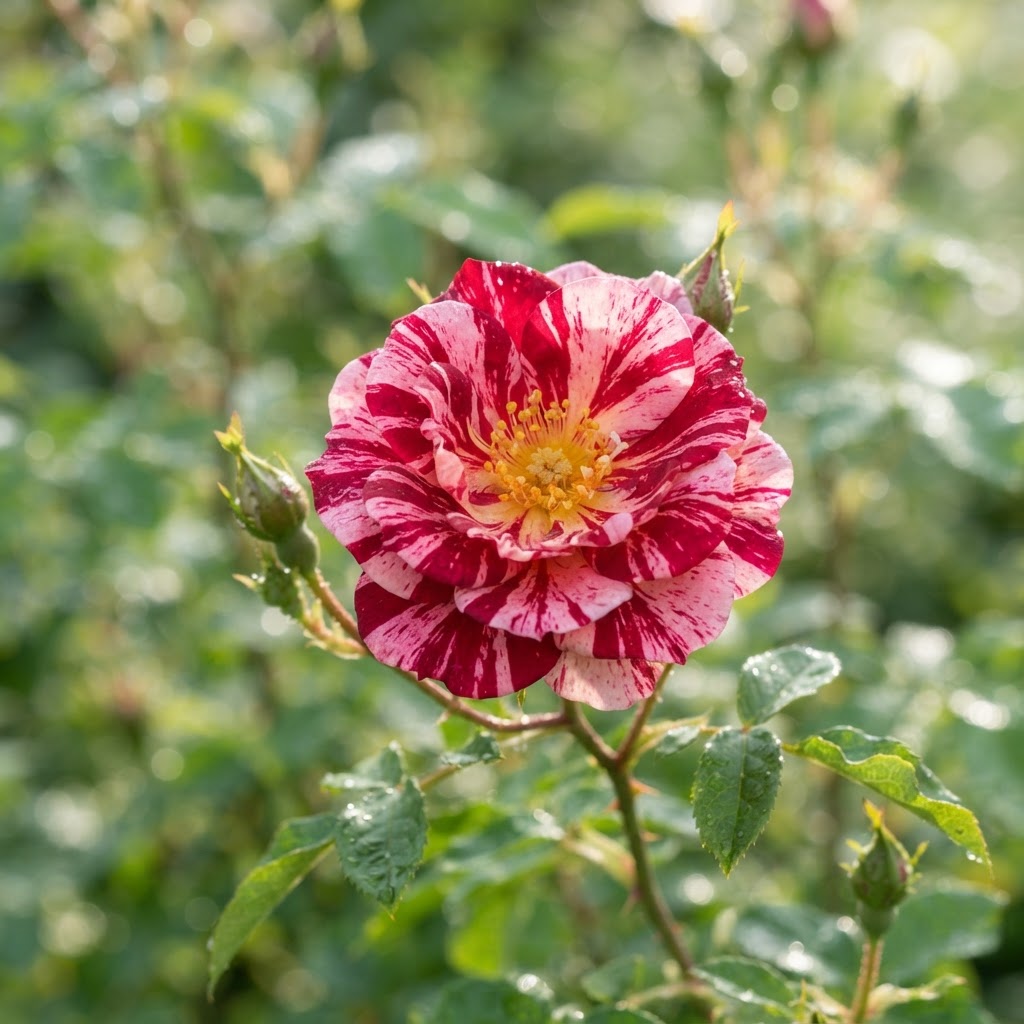
What is a chimera rose?
A chimera is a plant (or animal) built from two genetically different cell populations. In roses, the two cell lines sit in distinct layers inside the growing tip, called the meristem. The outer skin layer and the inner core layer can carry different genes for pigment — so when a petal forms, the cells that wrap around it and the cells that fill it may each paint their own color.
In the most striking chimeras, the two pigments stay in defined sectors. The result is a bloom with clean, geometric color breaks: a petal striped down the middle, a flower split into a red half and a pink half, or pinwheel stripes that radiate from the center like frosting swirled on purpose. Because the layering happens at the cellular level, every bloom on the bush shows the same painted pattern.
Importantly, a chimera rose is not a hybrid and not a grafted combination of two roses. It’s a single variety whose body is a patchwork of its own mutated cells.
How do chimera roses get created?
Chimeras begin with a spontaneous mutation in one cell of the meristem — the microscopic growing tip where every new leaf, cane, and petal is born. If that mutated cell ends up populating an entire layer of the meristem, the bush now grows with two distinct genetic layers: original on the inside, mutant on the outside (or vice versa).
This is what rose growers have always called a “sport,” and it can happen on any rose, at any time, without warning. Most sports change the whole plant uniformly — a climbing sport, for example. A sport only becomes a chimera when the mutation settles into just one meristem layer, leaving the others untouched.
Because the two cell lines live side by side in the growing tip, chimeras can only be preserved by vegetative propagation — cuttings, buds, or grafts. Propagate a chimera and the new plant inherits the same layered genetic patchwork. Save its seed, though, and the offspring get a reshuffled genetic deck: the layer arrangement is lost, and the two-tone pattern disappears.
Is every striped rose a chimera?
No — and this is the part that trips up even experienced rosarians. Many popular modern striped roses get their stripes from “jumping genes” (transposons): stretches of DNA that can switch a flower’s pigment gene on and off during petal growth, painting irregular, ever-changing streaks.
The practical difference is in the pattern. A true chimera tends toward clean, stable, sector-based color breaks that repeat identically on every bloom. Transposon striping is more freestyle — bold splashes and streaks that differ from bloom to bloom, sometimes even on the same plant. Both are beautiful; only one is a genuine two-genomes-in-one-plant chimera.
Famous chimera roses you can buy
The classic chimeras are old garden roses that have been passed along by cuttings for centuries — which is exactly how a chimera survives. These are the most beloved and easiest-to-find two-tone varieties:
Honorable mention goes to the modern “frosted paint” striped floribundas — red-and-cream ‘Scentimental’ and apricot-striped ‘Oranges ’n’ Lemons’. They carry the look via jumping genes rather than a layered chimera, but they rebloom all season and are far easier to find at retail garden centers.
- Rosa mundi (Rosa gallica ‘Versicolor’) — the ancient archetype. A striped sport of the crimson Apothecary’s Rose, with blush-pink petals splashed and flecked in deep rose-red. Once-blooming, hardy to zone 4, famously fragrant, and stocked by nearly every old-rose nursery.
- Austrian Copper (Rosa foetida ‘Bicolor’) — a glowing sport of the yellow Austrian Briar, with single coppery-orange petals backed in yellow. Famously unstable: one cane can suddenly bloom solid yellow, the parent rose peeking through the disguise.
- Ferdinand Pichard (Hybrid Perpetual, 1921) — rich crimson striped with pink and silvered white, strongly fragrant, and repeat blooming. The striped rose many gardeners meet first.
- Variegata di Bologna (Bourbon) — one of the most heavily striped roses ever sold, carmine pinwheels on white, with a heady old-rose perfume. A century-old classic that still earns front-row placement.
- Honorine de Brabant (Bourbon) — soft lilac-pink striped in mauve, with a relaxed, forgiving habit that shrugs off heat and humidity. A sentimental favorite across the American South.
Where to buy chimera roses (and what to know first)
True chimeras are old varieties, so specialty nurseries are your best hunting ground — particularly old-garden-rose and own-root specialists that propagate by cuttings. Check the specialist rose nurseries in your region, and expect the famous names to move fast in bare-root season.
Because chimeras can be scarce in general retail, collectors often hunt for years. That’s exactly what PetalPals’ availability watches are for: add a hard-to-find variety to your wishlist, set a watch, and get an alert when a nursery or a community member has it for sale.
- Buy from nurseries that propagate vegetatively — that’s the only way a chimera’s two-tone pattern carries over.
- Expect occasional reversion: a cane that blooms solid-colored is the parent (or sport) taking over — prune that cane out at the base to keep the striped pattern dominant.
- Gallicas and Bourbons like Rosa mundi and Honorine de Brabant are once-blooming or spring-heavy — plan a companion rebloomer if you want season-long color.
Common questions
Related guides
Top 10 Multicolored & Striped Roses
The best multicolored roses span four centuries: Rosa Mundi and Ferdinand Pichard for classic candy-striping, Fourth of July for a striped climber, and Peace for the most famous bicolor of all. Every pick below holds its pattern reliably (stripes do vary a little with temperature), and together they cover every garden use — shrub, climber, pillar, and pot.
Read the guide Top 10 ListsTop 10 Most Fragrant Roses
The benchmark fragrant roses are Mister Lincoln and Papa Meilland among red hybrid teas, Double Delight for spice-plus-sweet, and Gertrude Jekyll and Munstead Wood among modern shrubs — with the old Bourbon Madame Isaac Pereire as the all-out perfume champion. Every pick below is fragrant at garden-nose distance, not just when sniffed up close, and each carries its scent character — damask, tea, fruity, or myrrh — so you can choose the perfume you actually want.
Read the guide Care & DiagnosisDo Roses Need Chill Hours to Bloom?
Most roses do not need winter chill to bloom. Modern repeat-blooming roses — hybrid teas, floribundas, shrub roses, and nearly every rose sold at a garden center — flower on new growth, so mild winters simply mean more growth and more flowers. The exceptions are once-blooming old garden roses, ramblers, and some species roses, which need a seasonal rest to set their single big spring show and grow disappointingly in frost-free climates.
Read the guideKeep this guide in your pocket
PetalPals journals every rose you grow, reminds you when to spray and feed, and helps you identify problems from a single photo — free to join.