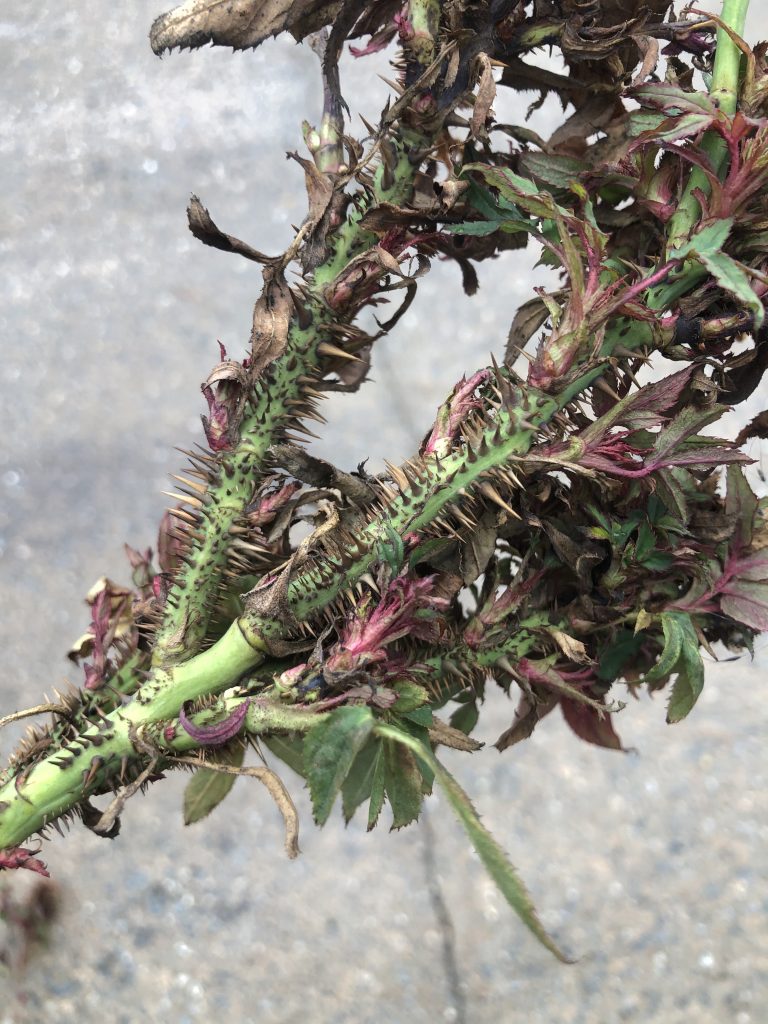
What are the symptoms of rose rosette disease?
The classic symptoms are witch’s brooms — clusters of shoots growing abnormally dense and fast — along with thick, rubbery, often deep-red stems crowded with soft thorns, distorted and stunted leaves, and buds that stay distorted or bloom deformed. The key tell is that symptomatic shoots stay red and never mature into normal green growth.
Do not confuse this with healthy new growth: many roses push reddish shoots in spring, but those mature to green with normal leaves and spacing. RRD shoots stay distorted, thornier than the rest of the plant, and get worse week by week.
- Witch’s brooms: dense, brushy clusters of shoots, often from one point
- Stems abnormally thick or rubbery, staying bright red instead of maturing green
- An explosion of soft, pliable thorns on new growth
- Distorted, wrinkled, stunted leaves; deformed or aborted buds
- Rapid, out-of-character growth on one part of the bush
How does rose rosette disease spread?
RRD is spread by a microscopic eriophyid mite that blows on the wind from rose to rose, and it moves on infected nursery stock and root pieces left behind after removal. The virus is systemic — it lives throughout the plant once established. Shrubs planted in tight groupings, like massed Knock Out roses, are infected easily because the mites travel between touching canes.
The mite is tiny enough that it travels on air currents for hundreds of yards, so infection can arrive from a neighbor’s yard and there is no spray that reliably stops it. Management is about catching it early and removing infected plants fast, before the mite population carrying the virus builds through the season.
What should you do if your rose has rose rosette disease?
Remove the entire plant — tops, canes, and roots — as soon as you are confident of the diagnosis, because the virus cannot be cured or pruned out. Bag the plant before carrying it through the garden to avoid scattering mites, and destroy it by trashing or burning, never composting. Then monitor your remaining roses closely for at least a season.
Some gardeners delay removal for a week or two to be certain — but every week the plant stands, the mite population inside it can carry the virus to its neighbors. When in doubt on a shrub rose, removing a single suspect is cheaper than losing the row.
- 1
Confirm the symptoms: witch’s brooms, thick red shoots, excessive soft thorns, distorted leaves that never normalize.
- 2
Remove the whole plant, digging out as much of the root system as possible.
- 3
Bag the plant in place before carrying it out, so mites are not trailed across the garden.
- 4
Trash or burn the plant — do not compost it, and remove any root suckers that resprout.
- 5
Inspect remaining roses every week or two for the same symptoms and remove any that show them.
Can I plant roses again after rose rosette disease?
Yes, with precautions. Remove every piece of the old plant, including roots and resprouts, since root pieces can carry the virus. Give the site a season without roses if you can, and when you replant, space the new roses so their canes do not touch — good spacing is the best protection, because the mite walks between touching canes more easily than it flies.
There are no reliably RRD-resistant rose varieties, though reports vary by cultivar. The safer bet in a heavily affected neighborhood is a diverse planting: mixing roses with other shrubs slows mite movement in a way that a solid hedge of roses never will.
Common questions
Related guides
How to Get Rid of Black Spot on Roses
Black spot is a fungal disease that causes circular black spots on rose leaves, followed by yellowing and leaf drop. Treat it by removing every infected leaf, watering only at the base, and applying a fungicide every 7–14 days until new growth comes in clean. Prevent it with full sun, good airflow, and a thorough fall cleanup.
Read the guide DiseasePowdery Mildew on Roses: Treatment & Prevention
Powdery mildew is a fungal disease that coats rose leaves, buds, and new shoots in a white, talc-like powder, often distorting the growth. Treat it by pruning out infected shoots, improving sun and airflow, and spraying with sulfur, potassium bicarbonate, or a systemic fungicide until new growth is clean. Prevent it by avoiding crowded planting and heavy nitrogen feeding.
Read the guideKeep this guide in your pocket
PetalPals journals every rose you grow, reminds you when to spray and feed, and helps you identify problems from a single photo — free to join.