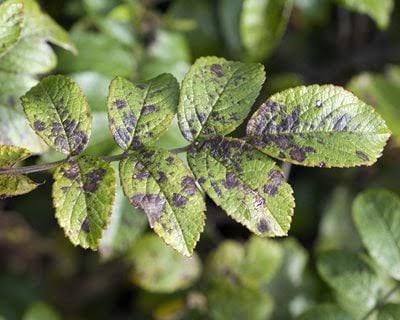
What is black spot on roses?
Black spot (Diplocarpon rosae) is the most common fungal disease of roses worldwide. It colonizes the foliage, forming black spots that yellow and drop each leaf, defoliating the plant from the bottom up. Black spot rarely kills a rose outright, but a badly defoliated bush is weakened, blooms poorly, and goes into winter more vulnerable to damage.
The fungus spreads by spores that splash from leaf to leaf and from the soil onto lower leaves during rain or overhead watering. It needs leaves that stay wet for roughly six to seven hours, which is why it takes off in stretches of humid, rainy weather when nights stay between roughly 60°F and 80°F.
Spores overwinter on fallen leaves and infected canes, so an outbreak in one season usually sets up the next one unless the debris is cleaned up.
What does black spot look like?
Black spot appears as circular black spots a quarter to half inch across with irregular, fringed or feathery edges on the upper leaf surface. The tissue around each spot turns yellow, and the leaf eventually falls off. Look for it first on the lowest, oldest leaves, especially after stretches of rain or humid weather.
Two lookalikes cause confusion: Cercospora leaf spot makes tan spots with dark purple margins rather than truly black ones, and spotted stems or canes can be from frost or physical damage rather than disease. If the spots have fuzzy, raised margins and the leaves yellow from the spot outward, it is almost always black spot.
- Round black spots with fringed or feathery margins on the upper leaf surface
- A yellow halo spreading around each spot before the leaf drops
- Defoliation that starts at the bottom of the bush and works upward
- Purple or black blotches on young canes during heavy infections
How do you treat black spot on roses?
Start by stripping every infected leaf you can reach and raking up and discarding all fallen leaves beneath the plant — never compost them. Then apply a fungicide every 7 to 14 days until the rose pushes clean new growth, rotating between products so the fungus does not build resistance. Fix the watering and airflow problems that allowed the outbreak, or it comes right back.
Organic options include neem oil, potassium bicarbonate combined with horticultural oil, and copper-based sprays such as Bonide Liquid Copper. Conventional options include chlorothalonil (Daconil or Bonide Fungonil), propiconazole (Fertilome Liquid Systemic Fungicide), and myclobutanil (Spectracide Immunox). Whichever you choose, remember that fungicides protect new growth — they do not erase existing spots, so sanitation is the step that actually turns the outbreak around.
- 1
Remove and destroy all infected leaves — strip them from the bush, rake the ground, and bin or burn them rather than composting.
- 2
Prune out crossing and inward-growing canes to open the center of the bush so foliage dries quickly after rain or dew.
- 3
Switch to drip or soil-level watering so the leaves never stay wet.
- 4
Spray a fungicide every 7–14 days and after every rain, covering both leaf surfaces; rotate between different active ingredients to slow resistance.
- 5
Refresh the mulch in fall and again in spring to bury overwintering spores in the soil.
How do you prevent black spot from coming back?
Prevention beats treatment: choose resistant varieties, give each bush full sun and room for air to move through it, water deeply at the base in the morning, and do a thorough fall cleanup of every fallen leaf. Where black spot is a yearly battle, a preventive spray schedule started in early spring — before symptoms appear — keeps foliage protected.
- Plant black-spot-resistant varieties — many modern shrub roses, Kordes, and David Austin introductions carry notably better resistance
- Space roses so air flows between them, and prune out crowded growth each spring
- Water at the base in the morning; avoid overhead sprinklers entirely
- Collect and discard fallen foliage in fall and refresh the mulch layer each spring
- In black-spot-prone climates, begin preventive fungicide sprays as leaves unfurl in spring
Will my rose recover from black spot?
Yes — black spot weakens roses but almost never kills a healthy, established plant. Once the wet, humid stretch that fueled the outbreak passes and the infected foliage is cleaned up, most roses push healthy new leaves within a few weeks. The real risk is repeated severe defoliation across seasons, which sends the plant into winter weak and reduces bloom the following year.
Support recovery with steady deep watering and a light feeding once the plant is growing cleanly again, but taper fertilizer by late summer so canes harden off before frost. Never prune out of panic mid-outbreak — removing leaves the rose still needs only adds stress.
Common questions
Related guides
Powdery Mildew on Roses: Treatment & Prevention
Powdery mildew is a fungal disease that coats rose leaves, buds, and new shoots in a white, talc-like powder, often distorting the growth. Treat it by pruning out infected shoots, improving sun and airflow, and spraying with sulfur, potassium bicarbonate, or a systemic fungicide until new growth is clean. Prevent it by avoiding crowded planting and heavy nitrogen feeding.
Read the guide Care & DiagnosisWhy Are My Rose Leaves Turning Yellow?
Yellowing leaves are a symptom, not a single disease. The pattern tells the story: yellow with black spots means black spot; yellow between green veins points to chlorosis; evenly yellow, dry leaves mean drought; and scattered yellow lower leaves in late summer can simply be natural aging. Match your pattern below to find the cause and the fix.
Read the guide DiseaseRose Rosette Disease: Symptoms, Spread & What to Do
Rose rosette disease (RRD) is an incurable virus spread by a microscopic mite, which makes new rose growth thick, red, overly thorny, and distorted — often in witch’s-broom clusters. There is no cure: a diagnosed rose must be removed entirely, roots and all, and destroyed rather than composted, to protect the other roses in your garden, especially shrub roses.
Read the guideKeep this guide in your pocket
PetalPals journals every rose you grow, reminds you when to spray and feed, and helps you identify problems from a single photo — free to join.