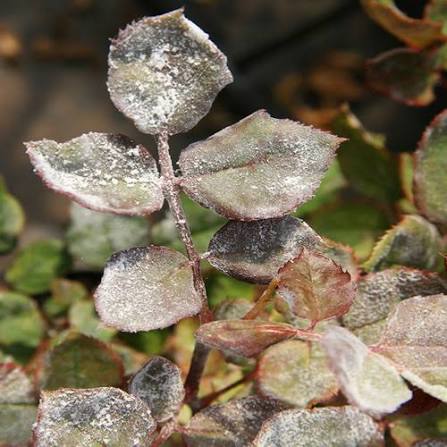
What is powdery mildew on roses?
Powdery mildew (Podosphaera pannosa) is a fungal disease that grows as a white, powdery coating across the surface of rose leaves, buds, and young stems. Unlike most rose diseases, it does not need wet leaves to grow — it thrives in warm days, cool nights, and high humidity, attacking the softest new growth first.
It is most active in spring and fall, and in gardens with morning shade where foliage stays cool and humid. Stressed or droughty plants are noticeably more susceptible than well-watered ones.
What does powdery mildew look like on roses?
Powdery mildew looks like white or gray talc dusted over the upper leaf surface, buds, and tips of new shoots. Infected leaves twist, crinkle, or curl upward, buds fail to open properly or open distorted, and heavily infected new growth is stunted. You can wipe the powder off with a finger — a quick field test for the disease.
The disease usually starts on the newest, softest growth and works downward and outward — the opposite pattern of black spot, which begins on the lowest leaves.
- White to gray powder on leaf surfaces, buds, and new shoots
- Twisted, puckered, or curled young leaves
- Buds that stall, distort, or fail to open
- Stunted, deformed flushes of new growth in warm, dry-soil weather
How do you treat powdery mildew on roses?
Prune out and dispose of the worst infected shoots, then spray with potassium bicarbonate, sulfur, or a systemic fungicide, repeating every 7–10 days until clean growth appears. Because stressed plants are more susceptible, water deeply during dry spells while you treat — a droughty rose and powdery mildew usually go together.
A widely used organic spray is a 1:9 milk-and-water solution applied weekly in sunny weather; trials show it can suppress mildew on roses, and it is harmless to blooms and pollinators. Avoid sulfur when temperatures exceed 85°F, as it can scorch foliage.
- 1
Prune out heavily infected shoots and bin them — do not compost mildewed growth.
- 2
Spray with potassium bicarbonate plus horticultural oil, wettable sulfur (Bonide Sulfur or Safer Brand Garden Sulfur), or a systemic fungicide such as Spectracide Immunox (myclobutanil), covering all surfaces of new growth.
- 3
Repeat every 7–10 days, and after rain, until the new flush comes in clean.
- 4
Water deeply at the base to relieve drought stress, which is itself a driver of the disease.
- 5
Ease up on nitrogen feeding — soft, sappy growth is what mildew loves most.
How do you prevent powdery mildew on roses?
Prevention centers on sun, space, and steady watering: give roses at least six hours of direct sun, allow air to flow between bushes, keep the soil evenly moist, and feed moderately so new growth is not unnaturally soft. In gardens with morning shade, an early preventive spray program in spring stops mildew before the first flush.
- Plant in full sun with good spacing so morning dew dries quickly
- Water deeply and consistently — drought stress invites mildew
- Feed moderately; avoid nitrogen-heavy fertilizers that push soft, sappy growth
- Choose resistant varieties and rake up mildewed leaves in fall, since the fungus overwinters on canes and debris
- Begin preventive sprays in early spring in mildew-prone gardens, especially where roses sit in morning shade
Common questions
Related guides
How to Get Rid of Black Spot on Roses
Black spot is a fungal disease that causes circular black spots on rose leaves, followed by yellowing and leaf drop. Treat it by removing every infected leaf, watering only at the base, and applying a fungicide every 7–14 days until new growth comes in clean. Prevent it with full sun, good airflow, and a thorough fall cleanup.
Read the guide Care & DiagnosisWhy Are My Rose Leaves Turning Yellow?
Yellowing leaves are a symptom, not a single disease. The pattern tells the story: yellow with black spots means black spot; yellow between green veins points to chlorosis; evenly yellow, dry leaves mean drought; and scattered yellow lower leaves in late summer can simply be natural aging. Match your pattern below to find the cause and the fix.
Read the guide Care & DiagnosisWhy Your Rose Isn’t Blooming: 6 Causes & Fixes
Roses that grow plenty of leaves but few or no blooms are usually missing sunlight — most varieties need at least six hours of direct sun — or are getting too much nitrogen, were pruned at the wrong time, or are still too young to flower well. Drought stress, deep planting, and pests eating the buds account for most of the rest. Work through the causes below.
Read the guideKeep this guide in your pocket
PetalPals journals every rose you grow, reminds you when to spray and feed, and helps you identify problems from a single photo — free to join.