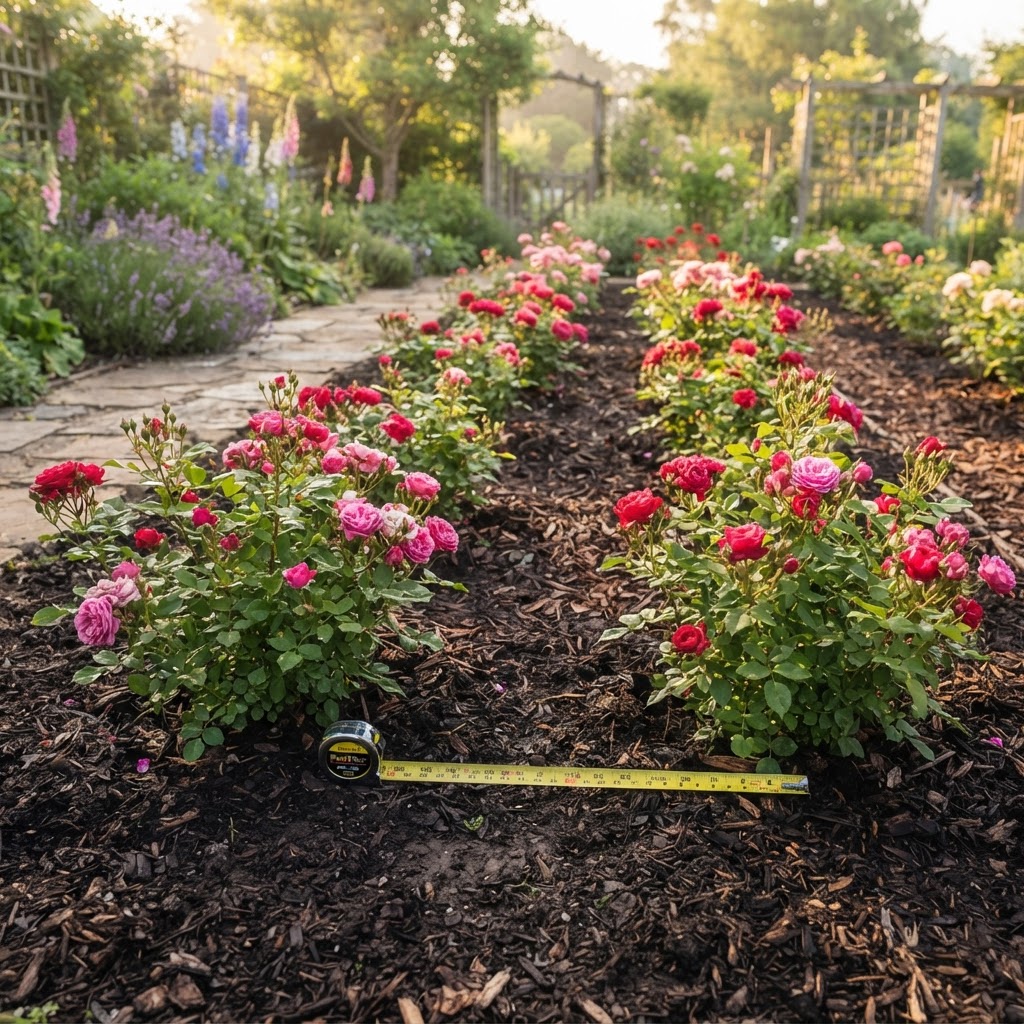
Why spacing matters more than most gardeners think
Roses planted too close compete for water, nutrients, and light, and they trap humidity inside the canopy, which is the setting fungal diseases such as black spot and powdery mildew prefer.
Roses planted too far apart are not harmed, but you lose the full, lush look and leave bare soil open to weeds.
The goal is simple: leaves should dry quickly after rain or watering, sunlight should reach the center of the plant, and you should be able to reach in to prune without a fight.
Spacing by rose type
These are general guidelines. Always check the tag for your specific variety, since vigor varies a lot.
| Rose type | Typical spacing | Notes |
|---|---|---|
| Miniature | 1 to 2 ft | Good for containers and borders |
| Hybrid tea | 2 to 3 ft (up to 4 ft in warm zones) | Upright, narrower habit |
| Floribunda | 2.5 to 3 ft | Bushy, flowers in clusters |
| Grandiflora | 3 to 4 ft | Tall, upright growers |
| Modern shrub and landscape | 3 to 5 ft | Varies widely by variety |
| English roses | 3 to 5 ft | Large, arching varieties need the high end |
| Old garden roses | 4 to 6 ft | Many form wide, dense shrubs |
| Rugosa | 3 to 5 ft | Suckering types spread over time |
| Climbers | 6 to 10 ft | Vigorous types can need more |
| Ramblers | 10 to 15 ft or more | Plan for a large structure |
Choosing the right spot
Spacing cannot fix a poorly chosen site. Sunlight, airflow, and drainage decide how well any spacing plan works.
- Sunlight: most roses want at least 6 hours of direct sun, with morning sun the most valuable because it dries dew early. In hot climates, afternoon shade helps prevent scorch
- Airflow: keep plants about 18 to 24 inches from walls, fences, and other perennials. Dense hedges and corners where air sits still are the highest-risk places for mildew
- Trees and shrubs: large trees compete hard for water and nutrients, so plant roses well outside the drip line of mature trees
- Soil and drainage: roses want well-drained soil. In heavy clay, give plants slightly more room and consider raised beds, since wet soil combined with crowded foliage invites disease
How to measure and plant
Measure center to center, plan for the mature size rather than the nursery size, and mark the layout before digging.
- 1
Plan for mature size, not nursery size. A small plant in a gallon pot may triple in width within a few seasons.
- 2
Measure center to center. Spacing is the distance between the middles of two plants, not between their edges.
- 3
Mark the spots first. Lay out stakes or pots before digging so you can judge the look.
- 4
Dig wide. A hole about 18 to 24 inches wide gives roots room to spread.
- 5
Decide how tight you want the look. For a full, mass-planted effect, space shrub roses so branches just touch at maturity. For specimen plants, give the full mature width.
When to plant: timing and season
Bare root roses go in while dormant in late winter to early spring. Container roses can be planted nearly any time the ground is not frozen.
Season also affects what you see. Roses look small in their first year, so patience is part of spacing. Resist the urge to squeeze in extra plants to fill the gap.
- Bare root roses: best planted in late winter to early spring while dormant, as soon as the soil can be worked
- Container roses: plant nearly any time the ground is not frozen, avoiding the hottest stretch of summer when young plants struggle
- Fall planting: works well in mild climates (roughly zones 8 to 10), and in cold climates if done early enough, about six weeks before the ground freezes, so roots can settle in
How zone and climate change the math
Cold-climate roses stay smaller and can sit closer. Warm-climate roses grow larger than the tag suggests and need extra room. Humid climates should always favor airflow.
- Cold zones (roughly 3 to 5): roses often die back in winter and stay smaller, so closer spacing is usually fine. Tighter planting can also make winter protection easier
- Moderate zones (6 to 7): standard spacing applies. This is where most spacing charts are written for
- Warm zones (8 to 10): roses grow year-round and can be much larger than the tag suggests. A hybrid tea that stays 3 feet tall in a cold climate may reach 5 or 6 feet, so add a foot or more of spacing
- Humid climates: prioritize airflow. Use the wider end of each range and choose disease-resistant varieties
- Dry climates: plants can sit a little closer because fungal pressure is lower, but water needs rise. Crowded roses in hot, dry, dusty conditions can also attract spider mites, so keep an eye on stressed plants
Spacing and pest resistance
Spacing will not make a plant immune, but it changes how easily problems start and spread.
- Fungal disease: good airflow shortens the time leaves stay wet, which lowers the risk of black spot and powdery mildew
- Spider mites: these favor hot, dry, stressed plants. Overcrowding adds stress, and dense foliage hides early damage
- Easier inspection: space to walk around each plant means you catch problems early
- Rose rosette disease: if you garden where it occurs, remove infected plants promptly and completely. Check with your local extension office for guidance in your region
Roses that tolerate crowding
These types are generally compact, vigorous, or bred for disease resistance, so they handle tighter planting better.
- Knock Out and other landscape shrubs: tough and disease resistant, often used in dense borders
- Drift roses: low, compact groundcover types suited to close spacing
- Flower Carpet roses: spreading, resilient, and good for mass planting
- Polyantha roses such as The Fairy: small, dense, and very hardy
- Miniature roses: naturally small, so they fit tight beds and containers
- Floribundas such as Iceberg: bushy and floriferous, though still give them some airflow in humid areas
Roses that need room
These grow large, spread widely, or are more prone to leaf diseases, so give them the generous end of the range.
- Large English roses (for example Graham Thomas or Gertrude Jekyll): tall, arching, and wide in warm climates
- Bourbon and other old garden roses: big, dense shrubs that appreciate airflow
- Hybrid teas known for mildew trouble: extra space helps them stay clean
- Vigorous climbers such as New Dawn: plan for a large support structure
- Rambling roses and Lady Banks: these can cover a fence, arbor, or small building
- Suckering rugosas: allow space for spread over time
Common spacing mistakes
Almost every spacing problem traces back to one of five habits.
- Planting for nursery size instead of mature size
- Placing roses against a solid wall with no gap
- Crowding hybrid teas into a bed with no airflow in a humid climate
- Mixing very vigorous roses next to delicate ones
- Forgetting that climbers need room at the base as well as above
Common questions
Related guides
Bare Root Roses: The Complete Beginner's Guide
A bare root rose is a dormant plant dug from the field and shipped without soil — it looks like a bundle of sticks, but it is the cheapest, widest-selection way to buy roses and often establishes faster than a potted plant. Success comes down to four things: soak the roots 8–24 hours before planting, get it in the ground while dormant, keep the soil moist (not swampy) for the first two months, and resist fertilizing until new growth appears. The steps below cover everything from choosing a healthy plant to your first blooms.
Read the guide Care & DiagnosisWhy Your Rose Isn’t Blooming: 6 Causes & Fixes
Roses that grow plenty of leaves but few or no blooms are usually missing sunlight — most varieties need at least six hours of direct sun — or are getting too much nitrogen, were pruned at the wrong time, or are still too young to flower well. Drought stress, deep planting, and pests eating the buds account for most of the rest. Work through the causes below.
Read the guide Care & DiagnosisTraining Climbing Roses: Creative Ways to Get Fuller, More Beautiful Vines
Climbing roses don’t actually climb — they grow long canes that you have to guide and tie. The secret to a wall of flowers instead of bare stems is the fan method: spread the main canes horizontally and diagonally across the support rather than letting them shoot straight up, because horizontal canes produce flowering shoots along their entire length. Start with a sturdy support, tie young flexible canes loosely into position while you can still bend them, and renew the framework gradually through pruning — the sections below cover trellises, arches, fences, pergolas, walls, and the mistakes to avoid.
Read the guide DiseaseHow to Get Rid of Black Spot on Roses
Black spot is a fungal disease that causes circular black spots on rose leaves, followed by yellowing and leaf drop. Treat it by removing every infected leaf, watering only at the base, and applying a fungicide every 7–14 days until new growth comes in clean. Prevent it with full sun, good airflow, and a thorough fall cleanup.
Read the guideKeep this guide in your pocket
PetalPals journals every rose you grow, reminds you when to spray and feed, and helps you identify problems from a single photo — free to join.