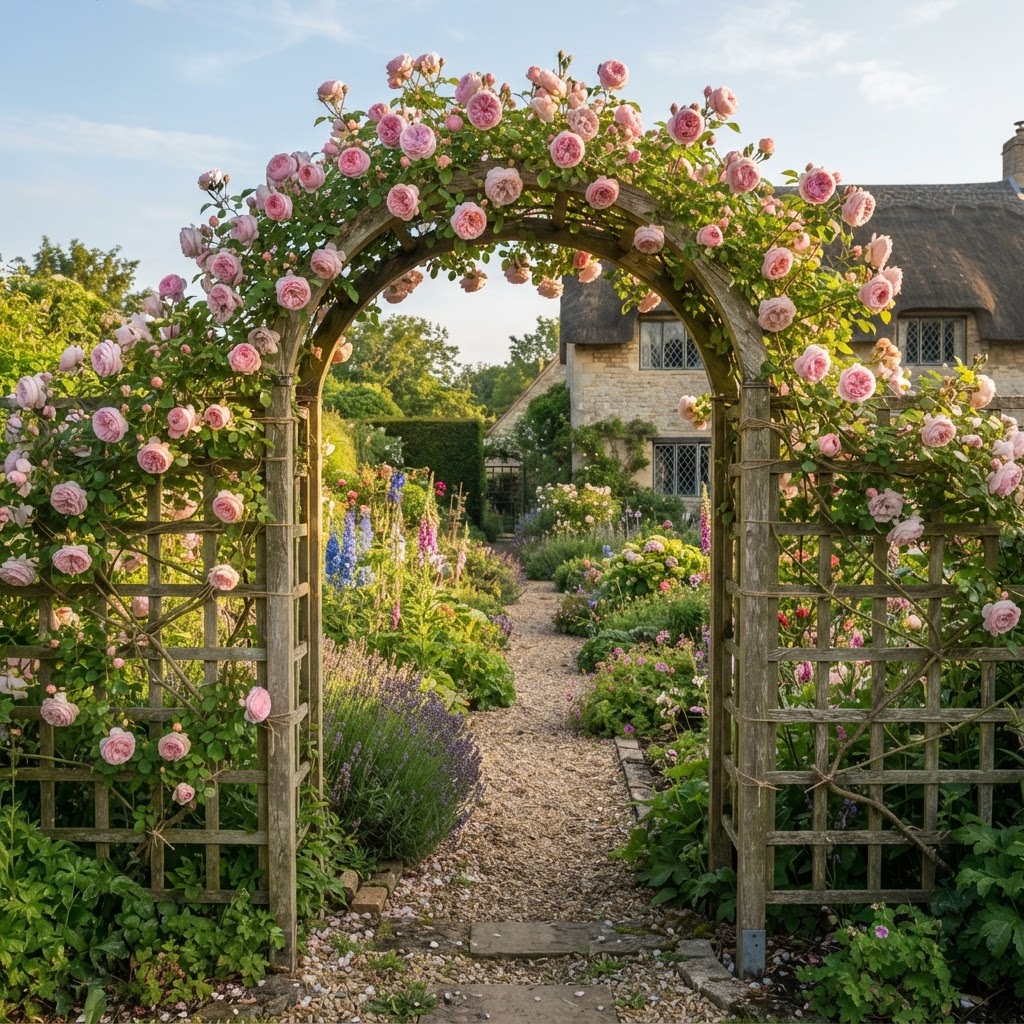
Why train a climbing rose?
Training helps you get flowers where you want them. A climbing rose naturally sends its strongest growth upward toward the light — so a rose left to grow vertically tends to bloom mostly at the top, with bare stem below.
When the main canes are trained horizontally or diagonally, they produce flowering shoots along their length. Instead of a narrow column of blooms at the very top, you get a curtain of flowers across the whole support — and a much more attractive framework for covering a fence, arch, or pergola.
The fan method: an easy way to train climbing roses
One of the easiest ways to think about training a climbing rose is to imagine a fan. Start with the strongest main canes near the base of the plant and gradually spread them outward as they grow — some left, some right, some diagonally upward, others across the middle.
You don’t need every cane to be perfectly horizontal. The goal is simply to avoid having all the growth going straight up. For a single rose growing against a wall or fence, a fan-shaped framework is often far more effective than tying every cane vertically.
- Spreads the plant across more space
- Helps distribute flowers along the canes instead of concentrating them at the top
- Makes better use of a trellis or fence
- Allows you to fill gaps as new canes emerge
- Makes future pruning easier
- Creates a more attractive shape
Choosing the right support for a climbing rose
Before you plant, think about how large the rose will eventually become. A young rose in a one-gallon pot may look innocent — give it three or four years and your “little climber” may have become a botanical linebacker.
Remember that the support needs to hold not just the rose, but the weight of mature stems, foliage, flowers and — in some climates — rain.
- Strong enough to hold a mature rose, not just the plant you bought
- Firmly anchored
- Large enough for the variety
- Easy to access for pruning
- Open enough for good airflow
- Designed so you can attach ties easily
How to train climbing roses on a trellis
A trellis is one of the easiest supports for a climbing rose, especially along a wall, fence, or narrow garden bed. Rather than sending every cane straight upward, use the trellis as a framework for creating a fan.
An extra trick: horizontal wires attached to sturdy posts can sometimes be more useful than a traditional trellis, because they give you the flexibility to position each cane exactly where you want it.
- 1
Choose your main canes — keep several strong, healthy canes that are growing in useful directions.
- 2
Spread them out — guide some to the left and some to the right.
- 3
Train them diagonally or horizontally — as the canes lengthen, gradually position them across the trellis.
- 4
Tie them loosely — use soft plant ties that won’t cut into the cane as it grows.
- 5
Fill the gaps — as new canes emerge, use them to fill empty areas of the trellis.
How to train climbing roses on an arch
Few garden features are as romantic as a rose-covered arch. The trick is to start training while the canes are still flexible — guide the strongest canes upward on either side, then gradually curve them over and across the top.
Don’t create one giant bundle of stems at the top. Spread them out, and think of the top of the arch as a framework the rose needs to fill rather than a single destination for every cane. Train several canes in different directions around the structure, and as flowering side shoots develop, they’ll eventually create the curtain of flowers you’re after.
Don’t underestimate the weight of a mature climbing rose, either — a flimsy decorative arch may not be enough for a vigorous variety.
How to train climbing roses on a fence
A fence is an excellent support for a climbing rose, particularly if you’re trying to create a flowering privacy screen. Attach horizontal wires or other sturdy supports at several heights and use them to spread the rose across the fence.
Again, think fan rather than ladder. Don’t send one cane straight to the top and then another straight up beside it — spread the framework sideways and diagonally so the rose can eventually flower across the entire area.
How to train climbing roses on a pergola
Pergolas give climbing roses plenty of room to show off. Train the main canes upward along the posts, then gradually guide them across the beams. Once the rose reaches the top, spread the canes in different directions — over time, the goal is a flowering canopy.
Start early: young canes are much easier to train than old, stiff ones. If a new cane is heading in exactly the wrong direction, don’t wait three years to deal with it — guide it while it’s flexible. Your future self will thank you.
How to train a climbing rose against a wall
Roses can look spectacular against walls, but avoid attaching the canes directly to the wall. Instead, create a support system using wires, hooks, brackets, or another suitable structure.
Leaving some space between the rose and the wall helps with airflow and makes pruning and maintenance easier. And remember: the wall is the backdrop — your support system carries the rose.
Can you train a climbing rose horizontally?
Yes — and it’s one of the most useful techniques for getting more flowers. The idea isn’t to force every cane into a perfectly horizontal line, but to gradually position the main canes sideways or diagonally as they grow, creating a framework from which flowering shoots can develop.
The support determines the shape. The principle stays the same.
- Fence or wall: one main cane running left, another right, others crossing the middle at different heights
- Arch: canes curving around the structure
- Pergola: canes spreading across the roof
How to train a young climbing rose
A young climbing rose may look disappointingly small compared with the structure you planted it beside. That’s normal — don’t feel compelled to make it cover everything immediately.
As new canes appear, guide them into useful positions and choose the strongest growth for your permanent framework. Resist the temptation to prune simply because the plant doesn’t look symmetrical — you’re building the architecture of the rose, not creating a topiary.
- Establishing healthy roots
- Encouraging strong new canes
- Protecting the plant from damage
- Beginning gentle training
How to prune climbing roses
Climbing roses shouldn’t automatically be treated like large shrub roses. The objective is usually to maintain a strong framework while gradually renewing older growth.
Then look at the oldest structural canes. If the plant has plenty of younger replacements, some older canes can gradually be removed to make room for new growth.
But don’t prune blindly. Different climbing roses have different flowering habits — some bloom primarily on older wood, while many repeat-flowering climbers can flower on newer growth as well. Know your rose before doing major pruning.
- Dead canes
- Damaged canes
- Diseased growth
- Very weak stems
- Badly crossing growth
- Growth that makes the plant excessively congested
When should you prune a climbing rose?
There isn’t one pruning date that works for every climbing rose — the best time depends on the variety, climate, and flowering habit. Once-blooming climbers and ramblers should be treated differently from repeat-flowering climbers.
If your rose flowers once in a spectacular flush, removing old flowering wood at the wrong time could mean removing next year’s flowers. If you’re unsure, identify the variety first and find out whether it flowers on old or new growth. When in doubt, don’t give a mature climbing rose a dramatic haircut just because it looks untidy.
How to get more blooms on a climbing rose
If your climber is producing lots of leaves but relatively few flowers, look at the basics.
- Train the canes — especially if they’re growing almost entirely vertically
- Give the rose enough sun — roses generally need plenty of sunlight for strong flowering
- Don’t overdo nitrogen — excessive nitrogen encourages lush foliage without necessarily producing more flowers
- Water deeply — during dry periods, thorough watering is generally more useful than frequent shallow watering
- Avoid unnecessary pruning — you may be removing flowering wood
- Be patient — some climbing roses need several years to establish their framework before putting on the display you imagined
Best climbing roses for arches
The best climbing rose for an arch depends on the size of the structure and your climate. Some varieties worth considering:
Always check the mature size before choosing a rose for a small arch.
- New Dawn — a vigorous, romantic climber with soft pink flowers and enough growth to make a substantial structure look impressive
- Eden — known for its large, old-fashioned flowers and excellent presence on larger supports
- Cecile Brunner — smaller flowers give this rose a softer, more delicate look
- Zephirine Drouhin — fragrant and notably low in thorns, making it appealing around pathways and entrances
- Crown Princess Margareta — a strong choice for a substantial structure where you want warm apricot-toned flowers
- Golden Showers — a classic choice if you’re looking for yellow flowers
Best climbing roses for pergolas
A pergola gives you more room to experiment with larger climbers. The important thing isn’t simply finding the “best” climbing rose — it’s finding the right-sized rose for your structure.
A rose that is perfect for a 12-foot pergola could be completely overwhelming on a small garden arch.
- New Dawn
- Eden
- Golden Showers
- Lady of Shalott
- Crown Princess Margareta
- Paul’s Himalayan Musk for large spaces
What vines grow well with climbing roses?
A climbing rose doesn’t have to be the only vine on your structure. Combining a rose with another flowering vine can extend the season of interest and create a more layered look — but choose companions carefully. You want a partner, not a hostile takeover.
- Clematis — the most classic companion; it weaves through the rose framework and adds another layer of flowers, with varieties for different seasons, colors, and growing conditions
- Star jasmine — in mild climates, provides evergreen foliage and fragrant flowers, keeping the structure attractive after the roses finish blooming
- Honeysuckle — adds fragrance and wildlife interest; choose the variety carefully and keep it pruned so it doesn’t overwhelm the rose
- Sweet peas — annual sweet peas are a great temporary companion, particularly around young climbing roses that haven’t yet filled their support
- Passionflower — in suitable climates, a spectacular combination of flowers and foliage, but it can be vigorous, so be prepared to keep it under control
How to create year-round interest with climbing roses
Instead of trying to find one rose that flowers constantly, think about the whole structure.
This approach creates a garden feature that has something going on for much more of the year.
- Early season: combine the rose with sweet peas, early clematis, spring bulbs, and other early-flowering plants
- Summer: let the rose and companion vines take center stage
- Fall: choose plants with late flowers, attractive foliage, or colorful hips
- Winter: evergreen companions such as star jasmine keep the structure looking alive while deciduous roses are resting
Rose + clematis: a classic combination
If you’ve ever seen a rose and clematis growing together, you know why gardeners love it: the rose provides the framework, the clematis threads through it, and together they create layers of flowers at different heights.
But don’t simply plant the most vigorous rose and the most vigorous clematis you can find — two aggressive growers sharing one support can quickly become a maintenance project. Look for compatible growth habits and give both plants room.
What NOT to do when training climbing roses
Most training problems come from a handful of avoidable mistakes.
- Don’t use a weak support — that decorative trellis might look sturdy in the nursery; a mature rose may have other opinions
- Don’t tie canes tightly — leave room for the cane to grow
- Don’t force thick, old canes — if a mature cane doesn’t want to bend, gradually redirect younger growth instead
- Don’t send every cane straight upward — you’ll often end up with flowers concentrated toward the top
- Don’t plant a vigorous vine without considering its mature size — your rose shouldn’t become a support structure for a vine that eventually swallows it
- Don’t prune a climbing rose like a shrub — learn how your particular rose flowers before deciding how much to remove
- Don’t remove every old cane at once — renew the framework gradually when appropriate
- Don’t forget the structure — inspect the support, ties, and attachment points every year; your rose may be considerably larger than the last time you looked
Creative climbing rose ideas
You don’t need to settle for the standard rose-on-a-trellis arrangement. Here are some ideas for turning climbing roses into garden features.
If you’re growing enough roses to need labels on a fence, you’re probably already a collector. When combining two roses, just make sure they have reasonably compatible growth habits.
- The rose umbrella — train one or more climbing roses over a large umbrella-shaped frame for a spectacular focal point in the middle of a garden
- A rose tunnel — place several arches in a row and train roses over them to create a flowering tunnel over a garden path
- A rose pillar — use an obelisk, column, or other tall structure for vertical drama without dedicating an entire wall to the rose
- A rose privacy screen — install a series of sturdy panels, train climbing roses across them, and add an evergreen companion for year-round screening
- A rose-covered gate — plant roses on either side of a garden gate and train them over the entrance; a simple project with a disproportionately dramatic result
- Turn a shed into a garden feature — instead of hiding a shed or utility structure, train a climbing rose across one side or around the entrance
- Combine two climbing roses — pink + white, apricot + cream, red + blush, yellow + white, or two shades of pink can all be beautiful on a large enough structure
- Create a rose collector’s wall — dedicate sections of a long fence to different varieties, with labels for name, breeder, year planted, color, fragrance, and your own rating
How much space does a climbing rose need?
There is no universal spacing recommendation, because climbing roses vary enormously in size. Before planting, look at the mature dimensions of the specific variety.
Buy for the mature rose, not the little plant in the pot.
- How vigorous it is
- How flexible the canes are
- Whether it repeats
- How much pruning it tolerates
- How large your support is
- How much sunlight the location receives
Can you grow a climbing rose in a container?
Yes — although not every climbing rose is a good candidate. Smaller or more manageable climbers can work well in large containers with a sturdy support.
The larger and more vigorous the rose, the more difficult container growing becomes.
- Large enough for the root system
- Heavy enough to remain stable
- Well drained
- Paired with a support that won’t topple
Climbing roses vs. rambling roses
The two terms are often confused, but their growth habits can be quite different. Climbing roses generally produce stronger structural canes, and many varieties repeat flower. Rambling roses tend to produce longer, more flexible growth, and many bloom once — often putting on an extraordinary display for a few weeks.
A rambler can be spectacular over a large pergola, tree, or expansive structure. A climbing rose may be easier to manage where you want a more controlled framework and repeat blooms. When choosing a plant, look beyond the word “climbing” on the label and research the growth habit of the individual variety.
A simple annual maintenance routine
You don’t need to spend your entire gardening life fighting your climbing rose. A regular routine is much easier.
- Winter (or your appropriate pruning season): remove dead and damaged canes, remove badly crossing growth, renew older structural canes when appropriate, replace worn ties, and inspect the support
- Spring: train new canes, fill empty spaces, mulch, fertilize if needed, and check for pests and disease
- Summer: continue tying new growth, deadhead repeat bloomers if desired, water deeply during dry weather, and keep vigorous companion vines under control
- Fall: clean up diseased foliage, continue watering as needed, avoid unnecessary heavy pruning, and enjoy late flowers and rose hips
Common questions
Related guides
Top 10 Climbing Roses for Zone 6
The best climbing roses for zone 6 combine real cold hardiness with repeat bloom: New Dawn, Eden, Climbing Iceberg, Don Juan, and Westerland top the list. Each pick below is hardy to at least zone 6 without special protection, repeats through summer rather than blooming once, and has the vigor to cover an arch, fence, or pillar within a few seasons.
Read the guide Top 10 ListsTop 10 Climbing Roses for Zone 7
Zone 7 opens the door to the big, romantic climbers that need more warmth: Lady Banks, Mermaid, and the old Noisettes lead the list. Every pick below is fully hardy in zone 7, healthy without routine spraying, and big enough to cover a wall, pergola, or fence — choose repeat bloomers if you want flowers all season, and the once-bloomers for one jaw-dropping spring show.
Read the guide Care & DiagnosisWhy Your Rose Isn’t Blooming: 6 Causes & Fixes
Roses that grow plenty of leaves but few or no blooms are usually missing sunlight — most varieties need at least six hours of direct sun — or are getting too much nitrogen, were pruned at the wrong time, or are still too young to flower well. Drought stress, deep planting, and pests eating the buds account for most of the rest. Work through the causes below.
Read the guide Top 10 ListsTop 10 Most Fragrant Roses
The benchmark fragrant roses are Mister Lincoln and Papa Meilland among red hybrid teas, Double Delight for spice-plus-sweet, and Gertrude Jekyll and Munstead Wood among modern shrubs — with the old Bourbon Madame Isaac Pereire as the all-out perfume champion. Every pick below is fragrant at garden-nose distance, not just when sniffed up close, and each carries its scent character — damask, tea, fruity, or myrrh — so you can choose the perfume you actually want.
Read the guideKeep this guide in your pocket
PetalPals journals every rose you grow, reminds you when to spray and feed, and helps you identify problems from a single photo — free to join.