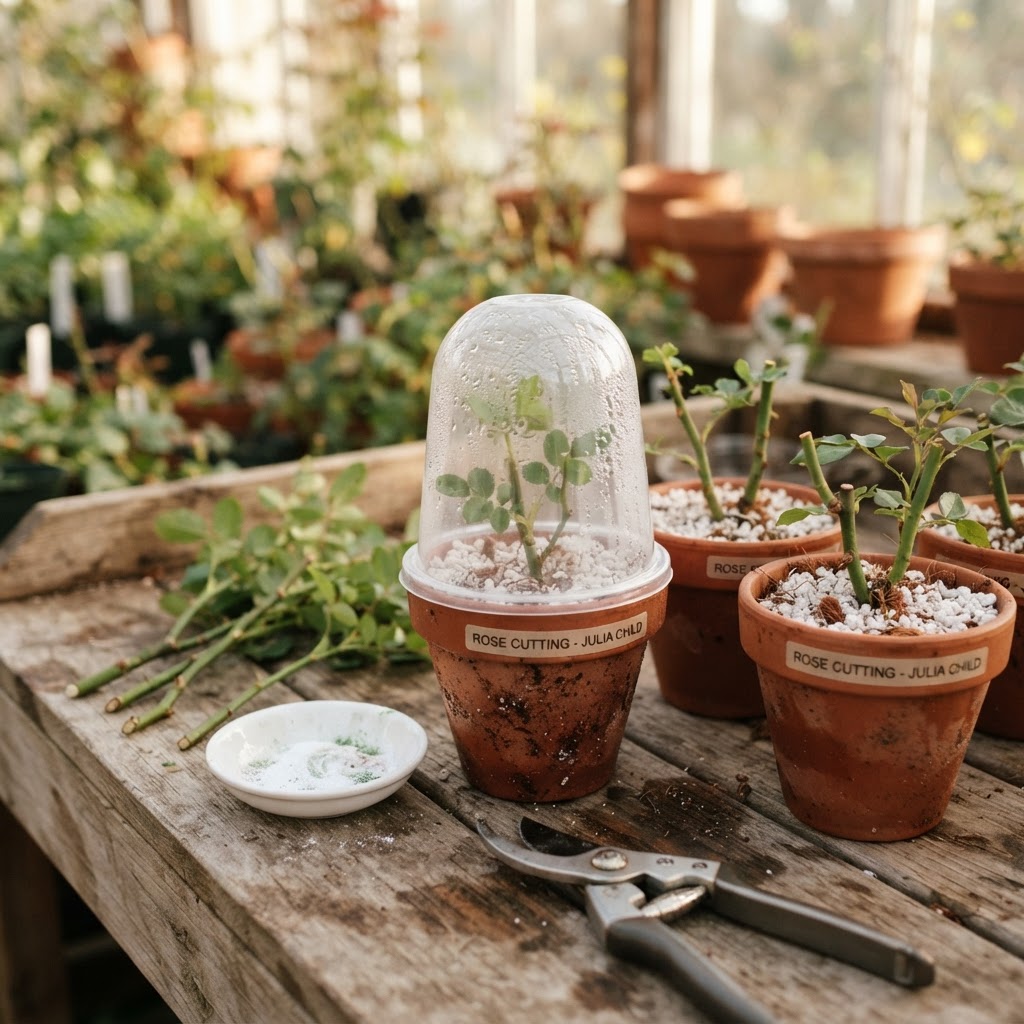
Can you grow a rose from a cutting?
Yes — many roses can be propagated from stem cuttings. A cutting taken from a healthy rose plant can develop roots and grow into a new plant that is genetically identical to the parent.
Because the new plant is a clone of the parent, it will have the same flower color, fragrance, bloom form, and growth habit as the original rose.
Many shrub roses, climbers, old garden roses, and landscape roses root readily from cuttings. Some varieties are easier than others, but the process itself is surprisingly simple.
When is the best time to take rose cuttings?
Rose cuttings can be taken at different times of year, but the stage of the stem — not the calendar — is what matters most. Late spring through summer is the easiest window for most home gardeners.
For most home gardeners, late spring through summer is the easiest time to achieve success.
- Softwood cuttings (spring): taken from fresh, flexible new growth. They root fast with a high success rate, making them ideal for beginners — but they are more sensitive to drying out.
- Semi-hardwood cuttings (summer): taken from stems that have begun to mature but are not fully woody. Often the best balance between vigor and durability, with excellent rooting potential.
- Hardwood cuttings (fall and winter): taken from dormant woody stems. Easy to collect and less prone to wilting, but slower to root.
What you'll need
Propagation takes only a handful of basic supplies, most of which you probably already have in the potting shed.
- Sharp, clean pruners
- Healthy rose stem
- Small pot or container
- Quality propagation mix
- Rooting hormone (optional)
- Plastic bag, humidity dome, or clear container
- Water
How to propagate roses from cuttings, step by step
Take a healthy 6–8 inch stem with 3–4 leaf nodes, strip the lower leaves and any blooms, dip it in rooting hormone, and plant it in a light, airy propagation mix kept humid and out of direct sun.
- 1
Select a healthy stem that recently flowered and is free of disease, pests, or damage — about the thickness of a pencil.
- 2
Cut a section approximately 6 to 8 inches long, making the bottom cut just below a leaf node where leaves emerge from the stem. The cutting should contain at least 3 to 4 leaf nodes.
- 3
Remove any blooms, buds, or developing flowers so the cutting directs its energy toward root production rather than flowering.
- 4
Remove leaves from the lower half of the cutting, leaving a few at the top to continue photosynthesis.
- 5
Apply rooting hormone (optional): dip the lower end of the cutting into it. Many roses root without it, but hormone can improve success rates and speed root development.
- 6
Plant the cutting in a suitable propagation mix, inserting it so at least two nodes are below the surface, then gently firm the mix around the stem (see the mix recipes below).
- 7
Create humidity: place a clear plastic bag over the pot or use a humidity dome to reduce moisture loss while roots develop, keeping the cover from touching the leaves whenever possible.
- 8
Provide bright indirect light — a bright spot out of direct afternoon sun. Strong sunlight can overheat and dry out unrooted cuttings.
- 9
Keep the mix consistently moist but never soggy. Overwatering is one of the most common causes of failure.
- 10
Wait for roots. Most rose cuttings begin rooting within 4 to 8 weeks. New leaf growth can appear before roots fully develop, so avoid disturbing the cutting too early.
Choosing a propagation mix
A propagation mix has a different job than regular potting soil: it must hold moisture while still allowing plenty of air around the developing roots. Avoid heavy garden soil, compost-rich mixes, and dense clay soils — they stay too wet and encourage rot.
Our recommended mix for most gardeners trying rose cuttings for the first time: 50% perlite + 50% coco coir. It balances moisture retention, drainage, and aeration, and works well for most rose varieties.
- Perlite and peat moss (50/50): the classic propagation mix. Excellent drainage, good moisture retention, and widely used by nurseries — though peat moss is not a renewable resource.
- Perlite and coco coir (50/50): a sustainable alternative to peat with excellent aeration that is easy to wet and rewet. Quality varies by manufacturer.
- Perlite, coco coir, and potting mix (40/40/20): slightly more nutrients and an easier transition after rooting — forgiving for beginners, with a slightly higher risk of rot if overwatered.
- Pure perlite: exceptional aeration and very low disease pressure with excellent rooting rates — but no nutrients, and it needs more frequent watering.
- Coarse builder’s sand and perlite (50/50): an inexpensive, well-draining traditional mix. Containers are heavy and the mix can dry unevenly.
- Directly in a garden bed: in mild climates, cuttings can root outdoors in existing soil amended with coarse sand and compost. No transplant shock and minimal equipment, but less control over moisture and lower success rates in some climates.
How long does it take rose cuttings to root?
Most rose cuttings root in 4 to 8 weeks under favorable conditions. Some varieties root faster, while others can take several months.
Patience is often the hardest part of rose propagation.
- Rose variety
- Temperature
- Humidity
- Light levels
- Time of year
Can you root rose cuttings in water?
Yes, but success rates are often lower than rooting in a potting mix or propagation medium.
Roots formed in water can be fragile and may struggle when transplanted into soil. For the highest chance of success, most experienced rose growers prefer rooting directly in a light, well-draining growing medium.
Which roses root most easily?
Every variety is different, but gardeners report reliably good success with easygoing, vigorous classes of roses.
Some hybrid tea roses can be more challenging, but they are still worth trying.
- Many climbing roses
- Old garden roses
- Polyantha roses
- Shrub roses
- Knock Out® roses
- Drift® roses
- Iceberg
- New Dawn
- Eden
- Rainy Blue
Common mistakes when propagating roses
Most failed cuttings come down to one of five fixable mistakes — all of them avoidable with a little attention.
- Letting cuttings dry out: fresh cuttings lose moisture quickly, so high humidity is essential during the rooting stage.
- Using weak or diseased stems: healthy stems produce healthier roots.
- Too much direct sun: unrooted cuttings cannot replace the water lost through their leaves.
- Overwatering: constantly wet soil can cause rot before roots have a chance to develop.
- Being impatient: many gardeners pull cuttings too soon to check for roots and accidentally damage them.
What to do after roots form
Once your cutting has roots, ease it out of its protected environment gradually and let it establish before it goes into the garden.
A well-rooted cutting can often be planted into its permanent location within a few months.
- 1
Gradually remove the humidity cover over a week.
- 2
Move the plant into brighter light.
- 3
Continue regular watering.
- 4
Transplant into a larger container if needed.
- 5
Allow the young rose to establish before planting it in the garden.
Keep a propagation journal
Many successful rose growers keep notes on their propagation attempts. Tracking your results helps you identify which varieties, seasons, and methods work best in your climate.
Record the parent rose, the cutting type, your growing conditions, and weekly observations — then compare success rates across batches. Over a season or two, your notes tell you exactly what works in your garden.
To make it easy, we turned this into a free printable Rose Propagation Journal — you can download it at the top of this guide.
Common questions
Related guides
Bare Root Roses: The Complete Beginner's Guide
A bare root rose is a dormant plant dug from the field and shipped without soil — it looks like a bundle of sticks, but it is the cheapest, widest-selection way to buy roses and often establishes faster than a potted plant. Success comes down to four things: soak the roots 8–24 hours before planting, get it in the ground while dormant, keep the soil moist (not swampy) for the first two months, and resist fertilizing until new growth appears. The steps below cover everything from choosing a healthy plant to your first blooms.
Read the guide Care & DiagnosisTraining Climbing Roses: Creative Ways to Get Fuller, More Beautiful Vines
Climbing roses don’t actually climb — they grow long canes that you have to guide and tie. The secret to a wall of flowers instead of bare stems is the fan method: spread the main canes horizontally and diagonally across the support rather than letting them shoot straight up, because horizontal canes produce flowering shoots along their entire length. Start with a sturdy support, tie young flexible canes loosely into position while you can still bend them, and renew the framework gradually through pruning — the sections below cover trellises, arches, fences, pergolas, walls, and the mistakes to avoid.
Read the guideKeep this guide in your pocket
PetalPals journals every rose you grow, reminds you when to spray and feed, and helps you identify problems from a single photo — free to join.