First, find your zone
Your USDA hardiness zone is based on the average coldest temperature where you garden, and it is the single most useful number for planning winter care. Most gardeners already know their zone, but if you do not, the official USDA Plant Hardiness Zone Map lets you look it up by zip code in seconds.
One note as you read the zone sections below: in the colder sections, the lists are roses rated hardy to those zones, with roses from the PetalPals catalog linked. In the warmer sections, the lists are roses that especially excel in the heat, from the catalog and from proven warm-climate grower recommendations. Roses without a link are proven favorites we have not added to the catalog yet.
Fall prep that applies to every zone
Wherever you garden, winter protection starts in late summer with what you stop doing, not what you build. Roses need to slow down, set wood, and go fully dormant before deep cold arrives, and a few timing rules make that happen.
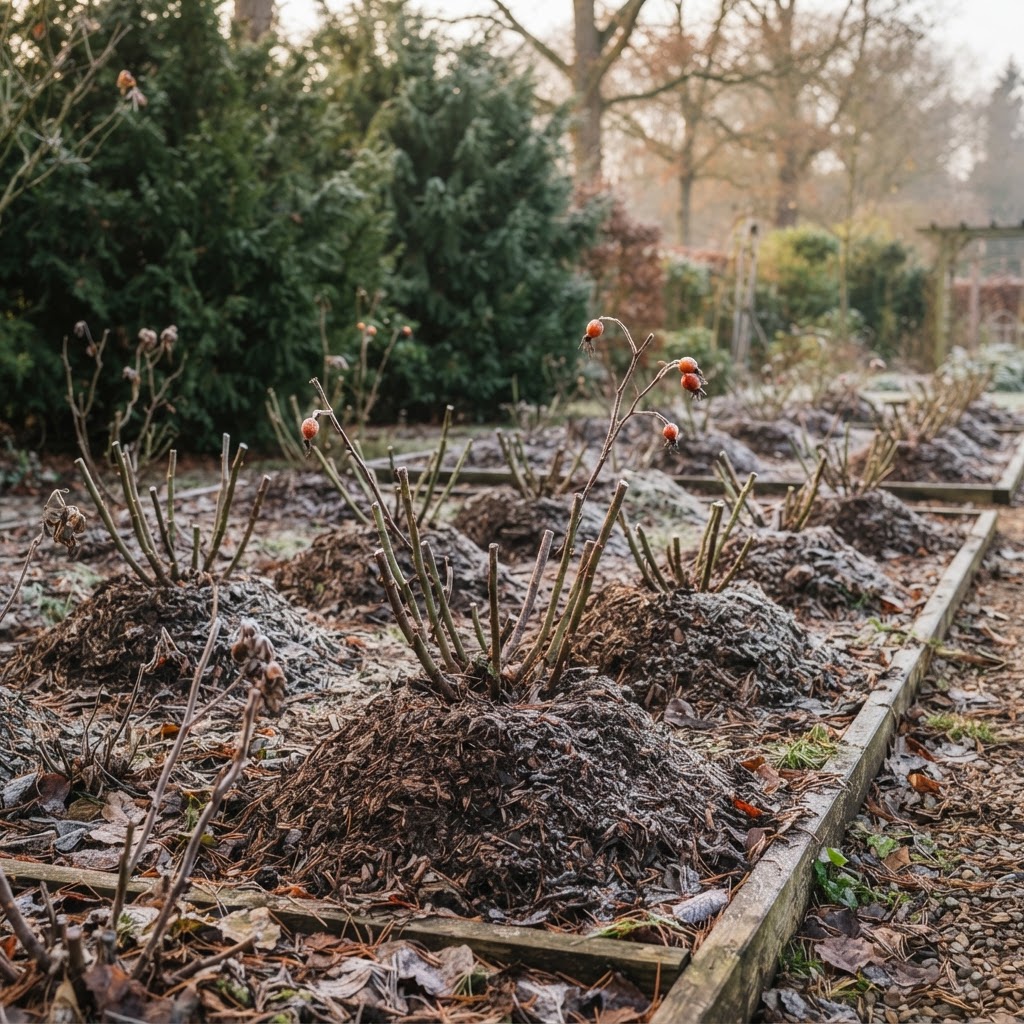
That last point is the one beginners most often skip, and it matters everywhere. Mounding too early keeps the crown warm and damp, which delays dormancy and invites rot and rodents. The mound should lock in cold, not add warmth, and the plant should already be asleep when you tuck it in.
- Stop fertilizing 6 to 8 weeks before your first expected frost so new growth can harden off
- Stop deadheading in early fall so the plant sets hips and eases into dormancy
- Keep watering through fall; well hydrated plants handle cold better than dry ones
- Rake and remove fallen leaves after the first frost, since fungal spores overwinter on them
- Hold off on real pruning until late winter or spring, when you can see what survived
- Wait for a hard frost before mounding, so the rose is truly dormant and stays that way
Overwintering roses in zones 3 and 4
Cold climate rose growing is its own tradition: the Canadian Explorer and Parkland series, rugosa hybrids, and a handful of tough shrubs were bred precisely for zone 3 and 4 winters, so even the coldest gardens have real choices. Protection here is a full program: start after several hard frosts, when the ground has begun to freeze, which is typically late October through mid November in zone 4 and a few weeks earlier in zone 3.
The core protection is a mound 10 to 12 inches deep over the crown and, on grafted roses, the bud union, made of compost, shredded leaves, straw, or soil. Around that mound you have options many growers in colder areas use: a ventilated rose cone, a burlap wrap stuffed with leaves, or a wire cage filled with loose mulch. Tall canes should be shortened to about waist height in late fall so wind cannot rock the plant loose at the roots.
Normal dieback in zones 3 and 4 is significant: a foot or two of tip dieback on even the toughest shrubs is routine, and after the coldest winters an own-root rose can be killed back to the mound and regrow from the crown. That is the plant working as designed. A plant in trouble looks different: canes that turn black and shrivel all the way to the soil line, or no new basal growth by early summer. If the plant is grafted and killed to the ground, it may regrow as rootstock rather than the variety you planted, which is why protecting the bud union matters so much here.
- Most common mistake: mounding too early in the fall, which keeps the crown warm and damp
- Rose cones must be vented; sealed cones cook a plant on sunny winter days
- Uncover gradually in early to mid April in zone 4, and late April in zone 3, on a mild overcast day
- 1
Therese Bugnet · Rugosa · Bred in Saskatchewan; a zone 2 to 3 legend that reblooms through short seasons.
- 2
Morden Blush · Shrub · Parkland series; the most floriferous and long blooming of the Parkland shrubs.
- 3
William Baffin · Climber · Explorer climber rated to zone 2b, near indestructible.
- 4
John Cabot · Climber · Explorer climber, zone 3 hardy, with deep pink double blooms.
- 5
Jens Munk · Rugosa · Explorer rugosa hybrid; among the hardiest and most fragrant.
- 6
Hansa · Rugosa · An heirloom rugosa from 1905, hardy to zone 3 with old rose perfume.
- 7
Adelaide Hoodless · Shrub · Parkland shrub with red blooms, bred for the Canadian prairie.
- 8
Winnipeg Parks · Shrub · Compact Parkland shrub that thrives in very short seasons.
- 9
Morden Fireglow · Shrub · Glowing orange red Parkland shrub for the coldest climates.
- 10
Queen of Sweden · Shrub · An English shrub confirmed hardy to zone 4, upright with a rich myrrh scent.
Overwintering roses in zones 5 and 6
Zones 5 and 6 are the heart of American rose country, where most rose classes can be grown and where a modest protection program makes the biggest difference. Start protecting once the ground has begun to freeze: early to mid November in zone 5, late November through December in zone 6.
The mound is the whole program for most roses here: 10 to 12 inches of compost, shredded leaves, or bark over the crown and bud union, applied after a hard frost. Hardy own-root shrubs, especially varieties bred for cold, often need nothing beyond fall cleanup. Grafted hybrid teas, grandifloras, floribundas, and anything in its first winter deserve the full mound, and a burlap screen on the windward side helps exposed sites.
Normal dieback in zones 5 and 6 is modest: expect up to a foot of tip dieback on grafted roses in an average winter, while well sited own-root shrubs may show none. What means trouble is canes going black to the soil line on a rose that used to shrug off winter, or a crown that never breaks new growth by late spring. Grafted roses that die above the union may regrow as rootstock, so check whether new shoots look like the variety you planted.
- Most common mistake: hard pruning in fall, which invites dieback deeper into the cane
- A light second mulch on the windward side shields plants from drying winter wind
- Uncover in late March to mid April in zone 6, mid to late April in zone 5, on an overcast mild day
- 1
Golden Celebration · English Rose · Excellent disease resistance for an Austin, with large cupped blooms.
- 2
Olivia Rose Austin · English Rose · Vigorous, with very good disease resistance and repeat bloom.
- 3
Darcey Bussell · English Rose · Red crimson English shrub, rated hardy to zone 5 with a rich scent.
- 4
Scepter'd Isle · Shrub · Vigorous and disease resistant, with a strong myrrh scent.
- 5
Crown Princess Margareta · Shrub · A tall grower that can reach 12 ft, with a strong fruity fragrance.
- 6
Don Juan (1958) · Climber · Vigorous 6 to 14 ft climber with a strong old-rose perfume.
- 7
Benjamin Britten · English Rose · Strong fruity fragrance with hints of wine and pear.
- 8
The Alnwick Rose · Shrub · Strong, healthy growth with good disease resistance.
- 9
Carding Mill · English Rose · Very vigorous, with excellent disease resistance.
- 10
AUStango English Garden Shrub Rose · English Rose · Bred for improved resistance to common rose ailments.
Overwintering roses in zones 7 and 8
These are the climates where rose care gets easier, not harder: most rose classes overwinter here with little fuss, and hybrid teas find their sweet spot. There is no fixed date to start protecting: most winters, healthy established roses need only fall cleanup and a light mulch refreshed in November or December.
The roses that do want help are the same suspects as everywhere else: newly planted roses, grafted hybrid teas on the margin of their range, and climbers with long exposed canes. For those, a 4 to 6 inch mulch over the crown after the first frost is plenty, and tying climber canes securely to their support so wind cannot thrash them matters more than any mound. Do not build big cones or deep mounds here; in mild, wet winters they hold moisture against the crown and do more harm than good.
Normal dieback in zones 7 and 8 is close to none. Occasional tip burn after an unusually cold snap is normal and gets pruned away in spring. A plant in trouble shows blackened, shriveled canes below a few inches, or simply fails to leaf out while its neighbors are growing. Because crown damage is rare here, a struggling rose in zone 8 is more often a watering, drainage, or disease problem than a cold problem.
- Most common mistake: heavy mounding in mild winters, which traps moisture and rots crowns
- Keep fall cleanup thorough; mild winters are kind to fungal spores too
- No uncovering needed beyond pulling back an extra mulch in February or March as growth stirs
- 1
Blue Girl · Hybrid Tea · Large 5 inch blooms with a tea-like scent, from Kordes.
- 2
Mister Lincoln · Hybrid Tea · Very strong sweet fragrance on long-stemmed large blooms.
- 3
Dolly Parton · Hybrid Tea · A heavy damask scent on a strong, productive plant.
- 4
Kardinal · Hybrid Tea · Strong grower with large blooms excellent for cutting.
- 5
Lilas Rose · Shrub · High disease resistance on a compact 2 to 3 ft shrub.
- 6
Brandy · Hybrid Tea · Sweet, spicy fragrance on large 5 inch blooms.
- 7
Bing Crosby · Grandiflora · Good disease resistance and strong, productive growth.
- 8
Tropical Sunset · Hybrid Tea · Good disease resistance on a moderate to strong grower.
- 9
Lagerfeld · Grandiflora · Strong citrus scent, blooming in flushes through the season.
- 10
Eisvogel · Hybrid Tea · Fruity fragrance and flushes of globular 4 to 5 inch blooms.
Overwintering roses in zones 9 and 10
Zone 9 is the friendliest rose zone there is: more varieties grow well in it than in any other zone on the map, because nearly every rose class thrives where winters barely dip below freezing. In zones 9 and 10 winter protection is simply not a thing roses need: no mound, no cones, no wrapping, ever.
What winter means in these zones is a change of rhythm, not a siege. Many roses here never go fully dormant, blooming in fits through the cool months, so fall is for cleanup, adjusting irrigation downward, and enjoying a bloom season that much of the country only gets in June. Winter is also bare root planting season in these zones, which makes it one of the best times of year to add roses.
Normal dieback here is none. A rose dying back in zone 9 or warmer is telling you about water, soil, or pests, not cold. The mistake most often made in these zones is keeping the summer routine on autopilot: feeding on the same calendar into winter, which pushes soft growth in marginal months, or watering as heavily in the cool season as in June. Pull fertilizer back in late fall and let the slightly slower rhythm of the season do its work.
These are the best roses for these zones: proven heat performers drawn from the PetalPals catalog and from lists warm-climate growers recommend most. The list runs longer than the colder zones for a reason, and that reason is warmth. Roses without a link are proven favorites we have not added to the catalog yet.
- Most common mistake: feeding and watering on a summer schedule through the cool season
- Use the mild winter as planting season; bare root and potted roses establish beautifully now
- 1
Iceberg · Floribunda · The world's most planted floribunda, thriving in zone 9 and 10 heat.
- 2
Knock Out · Shrub · Rated to zone 11; blooms on through heat with near-zero black spot.
- 3
Belinda's Dream · Shrub · A Texas Earth-Kind legend, trouble-free in Gulf Coast heat.
- 4
Mutabilis · Old Garden Rose · The butterfly rose: blooms shift copper to pink to red, nonstop.
- 5
Old Blush China · Old Garden Rose · Blooms nearly year-round in warm zones and shrugs off heat.
- 6
Queen Elizabeth · Grandiflora · Tall, sturdy, and heat-proof; a zone 10 community favorite.
- 7
Julia Child · Floribunda · Buttery gold blooms keep coming through warm winters.
- 8
Souvenir de la Malmaison · Old Garden Rose · A Bourbon with tea scent that adores mild winters.
- 9
Perle des Jardins · Old Garden Rose · A classic Tea rose that blooms almost continuously in zone 10.
- 10
Duchesse de Brabant · Tea Rose · A soft pink Tea rose beloved in Gulf Coast and zone 10 gardens.
Overwintering roses in zone 11
A true tropical winter never tests a rose, but zone 11, in spots like coastal Southern California, south Florida, Hawaii, and the low desert, brings its own demands: year-round growth means year-round care. Plenty of varieties thrive here with proper attention, especially Chinas, Teas, and Noisettes bred for hot climates.
A zone 11 rose never goes fully dormant, so winter looks like gardening in a lower gear rather than stopping. Proper care here means consistent irrigation because tropical sun dries pots and raised beds fast, some afternoon shade in the low desert, vigilance against spider mites, thrips, and black spot, which never take a winter break, and a light feed after each bloom cycle instead of a calendar schedule.
The classic zone 11 survivors are Chinas, Teas, Noisettes, and the Bermuda mystery roses, found thriving untended in old Bermuda gardens. Heat-tolerant modern shrubs like Knock Out hold up too, and with the care above many more varieties thrive in zone 11 than cold-climate gardeners would guess.
These are the best roses for zone 11, a mix of catalog picks and time-tested name-only favorites:
- 1
Old Blush China · Old Garden Rose · Flowers in almost every month of a tropical year.
- 2
Safrano · Old Garden Rose · A Gulf Coast Tea rose that blooms without pause.
- 3
Louis Philippe · Old Garden Rose · The unkillable "cracker rose" of the deep South.
- 4
Mrs. Dudley Cross · Old Garden Rose · Thornless and virtually disease-free in south Florida.
- 5
Lady Hillingdon · Old Garden Rose · Coppery apricot blooms on a heat-loving Tea climber.
- 6
Ducher · Tea Rose · An ivory China-Tea that loves tropical winters.
- 7
Reve d'Or · Noisette · A climbing Noisette that flowers through the mildest winters.
- 8
Bermuda mystery roses · China and Tea seedlings · Found thriving untended in old Bermuda gardens; ideal in the tropics.
Container roses and roses in their first winter
A potted rose is effectively two zones colder than the same rose in the ground, because pot walls expose roots to cold air on every side. And a rose planted this year has a small root system and soft new growth, so it needs extra help in its first winter no matter which zone you garden in.
For containers, the goal is to keep roots from freezing solid and from thawing and refreezing in cycles. Move pots into an unheated garage, shed, or crawlspace where temperatures stay cold but above most of the root killing range, water lightly about once a month, and leave them unpotted from frost until early spring. If storage is not possible, bury the pot to its rim in a spare bed or heap leaves around the whole pot against a north wall.
For first year roses in the ground, apply your zone program generously: in zones 3 to 6 that means the full 10 to 12 inch mound, and in zones 7 and 8 a mound is worth the trouble the first winter even though established neighbors need none. Young plants are the ones that teach you the most about your garden, so it pays to keep them comfortable.
Spring checklist: uncovering and reading the survivors
Uncover gradually, on mild overcast days, and let the rose wake up in steps rather than all at once. Then read what survived before you touch the pruners.
A rose that died to the ground is not necessarily gone. Own-root roses often regrow from the crown or roots and catch up within a season or two. Give a silent plant until early summer before declaring it lost, and if you lost a grafted rose, check whether the new shoots match the variety or look like generic rootstock before you decide whether to keep it.
- Remove mounds in stages over a week or two, keeping frost cloth handy for late cold snaps
- Wait until after your last hard frost to prune, when forsythia blooms are a classic cue
- Scratch test each cane: green just under the bark is alive, brown or black is dead
- Prune back to live wood, cutting just above an outward facing bud
- Watch for basal breaks at the crown by late spring, a sign the crown survived even if canes did not
- Resume fertilizing only after real growth is underway, then water deeply as spring warms
Find roses rated for your winter
Many of the roses above are in the PetalPals catalog with their full profile, including the hardiness range each variety is rated for, so you can check any rose against your zone before it ever reaches your garden. Roses listed by name only are proven favorites we have not added to the catalog yet. Browse the catalog, open a variety page to see its zones, breeder, and fragrance, and save the ones you want to next season by adding them to a wishlist.
Winter care is mostly about starting with the right rose. If yours is rated comfortably for your zone, the work each fall is small. If you have been fighting to keep a tender rose alive every winter, our zone lists above are a good place to meet its low maintenance replacements.
Common questions
Related guides
Winter Rose Protection for Zones 6 & 7
Most hardy shrub roses in zones 6 and 7 need nothing more than a late-fall mound of mulch over the crown — 10 to 12 inches of compost, shredded leaves, or bark applied after the ground has begun to freeze. Grafted hybrid teas, floribundas, first-year plants, and marginally hardy varieties benefit from a bit more: fall cleanup, canes tied against wind, and for containers and tree roses, actual shelter. Everything else — rose cones, burlap, burying — is optional for the roses on our zone 6 and zone 7 lists.
Read the guide Care & Diagnosis8 Simple Things to Do Now to Prepare Your Roses for Fall
Fall rose care is less about doing more and more about doing the right things: ease up on fertilizer so the plant stops pushing tender growth, clean up fallen and diseased leaves, refresh the mulch, keep deep watering during dry spells, skip the heavy pruning, let some hips form, feed the soil, and start planning next year’s wish list. A little attention now means healthier plants, fewer disease problems, and a spectacular spring flush next year.
Read the guide Top 10 ListsBest Roses for Zone 6
The best roses for zone 6 combine genuine cold hardiness with season-long bloom: The Fairy, Carefree Beauty, Knock Out, Quietness, and William Baffin lead the list. Every pick here survives zone 6 winters (roughly -10 to 0°F at the coldest) with little or no special protection, and every one repeat-blooms from June to frost rather than flowering once in spring.
Read the guide Top 10 ListsBest Roses for Zone 7
In zone 7 you can grow nearly every class of rose — the challenge is summer heat and humidity, not winter. Mister Lincoln, Double Delight, Julia Child, Graham Thomas, and Belinda’s Dream top our list, chosen because they combine real beauty with proven staying power through zone 7’s long, muggy growing season. All ten repeat-bloom without any winter protection.
Read the guide Care & DiagnosisHow to Plant Roses for Beginners: A Step-by-Step Guide
Planting a rose comes down to four early decisions: pick a spot with at least 6 hours of sun and good drainage, choose a variety hardy in your zone, amend the soil with compost, and plant at the right time for your rose type. Do those four things well and the rest is routine care — deep watering, mulching, and a light feeding schedule.
Read the guide Care & DiagnosisAll About Roses: The Complete Guide to Rose Types, Hardiness Zones, Care and Best Varieties
Roses are sorted into three broad groups, species roses, Old Garden Roses (classes before 1867) and Modern Roses, and then into familiar classes such as hybrid tea, floribunda, grandiflora, shrub, climber, rambler, miniature and groundcover. Each type differs in size, bloom pattern, fragrance, hardiness and the care it needs. The right choice starts with your goal (cut flowers, color, fragrance or coverage) and your USDA hardiness zone.
Read the guideKeep this guide in your pocket
PetalPals journals every rose you grow, reminds you when to spray and feed, and helps you identify problems from a single photo — free to join.