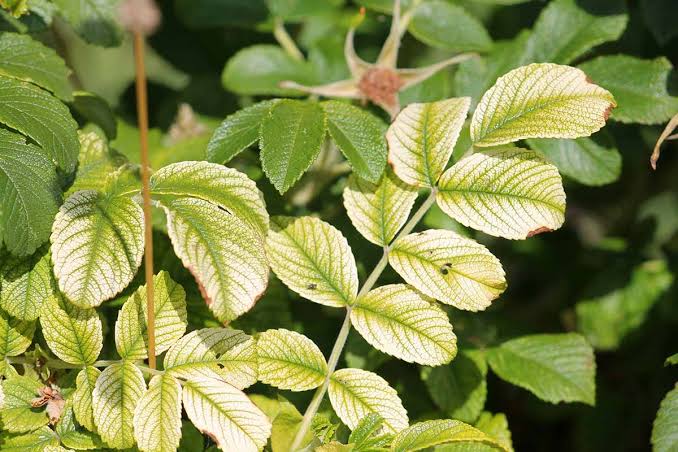
What does chlorosis look like on roses?
Chlorosis shows as pale yellow tissue between veins that stay sharp and green, like a leaf skeleton — usually on the newest, topmost leaves first. As it worsens, whole leaves pale to near-white or cream, edges scorch brown, and growth slows. The pattern is the tell: green veins on yellow tissue means a nutrient lockout, not a leaf disease.
- Interveinal yellowing — yellow between green veins, on the newest leaves first
- Severe cases: whole leaves cream or near-white with brown, scorched edges
- Slow, weak new growth and fewer or smaller blooms
- Often worst on one side of the plant or on shoots nearest pavement or masonry
What causes chlorosis in roses?
The dominant cause is soil pH: above roughly 7.2, iron that is present in the soil becomes chemically locked out to the roots. Close behind are soggy, compacted, or heavily watered roots — even in acid soil, waterlogged roots cannot take up iron. High phosphorus from years of heavy feeding and sensitive rootstocks compound the problem.
- Alkaline soil — common near limestone, new construction, concrete, and in arid regions
- Overwatering or poor drainage that suffocates the roots
- Compacted or heavy clay soil that stays cold and wet in spring
- Excess phosphorus from repeated fertilizer use, which blocks iron uptake
- Certain rootstocks, like multiflora, that are more sensitive to alkaline soil
How do you fix chlorosis in roses?
Two moves work together: apply chelated iron for a fast green-up — EDDHA-type chelates stay available even in alkaline soil — and fix the root cause. If the soil is alkaline, work in sulfur or acidifying amendments to lower the pH over the long term. If the roots are soggy, correct the watering and drainage before anything else, because iron feeds do nothing for drowning roots.
Expect the existing yellow leaves to stay yellow — iron feeds the new growth. If the next flush comes in green, the uptake problem is solved; if it yellows again within weeks, the pH or drainage issue is still active and needs the soil-level fix.
- 1
Do a soil test first — pH and nutrient levels determine which fix actually applies.
- 2
Apply chelated iron — EDDHA chelates such as Sequestrene stay available in alkaline soil, and Fertilome Chelated Liquid Iron and Bonide Liquid Iron are widely available — to soil or foliage; foliar sprays green leaves up within days but are temporary.
- 3
Water deeply but only when the top few inches dry out — overwatering is the most common hidden cause.
- 4
If pH is high, apply garden sulfur (Espoma Soil Acidifier is a common form) or organic acidifying amendments each season to bring it down gradually.
- 5
Mulch with compost to loosen soil over time; on heavy clay, consider moving the rose to a raised, better-drained spot.
Is it chlorosis, black spot, or something else?
Pattern separates them cleanly. Chlorosis is yellow tissue with crisp green veins, no spots, worst on new growth. Black spot is fringed black spots ringed with yellow, worst on the lowest leaves in wet weather. A uniform pale yellow on the oldest leaves points instead to nitrogen deficiency or simple late-season aging. Treat each cause differently, so read the pattern before reaching for a product.
One caution: Epsom salts are often recommended for yellowing roses, but magnesium deficiency is a different, rarer pattern — yellow bands on older leaves, sometimes with purple tints. It is not a chlorosis fix.
Common questions
Related guides
Why Are My Rose Leaves Turning Yellow?
Yellowing leaves are a symptom, not a single disease. The pattern tells the story: yellow with black spots means black spot; yellow between green veins points to chlorosis; evenly yellow, dry leaves mean drought; and scattered yellow lower leaves in late summer can simply be natural aging. Match your pattern below to find the cause and the fix.
Read the guide DiseaseHow to Get Rid of Black Spot on Roses
Black spot is a fungal disease that causes circular black spots on rose leaves, followed by yellowing and leaf drop. Treat it by removing every infected leaf, watering only at the base, and applying a fungicide every 7–14 days until new growth comes in clean. Prevent it with full sun, good airflow, and a thorough fall cleanup.
Read the guideKeep this guide in your pocket
PetalPals journals every rose you grow, reminds you when to spray and feed, and helps you identify problems from a single photo — free to join.